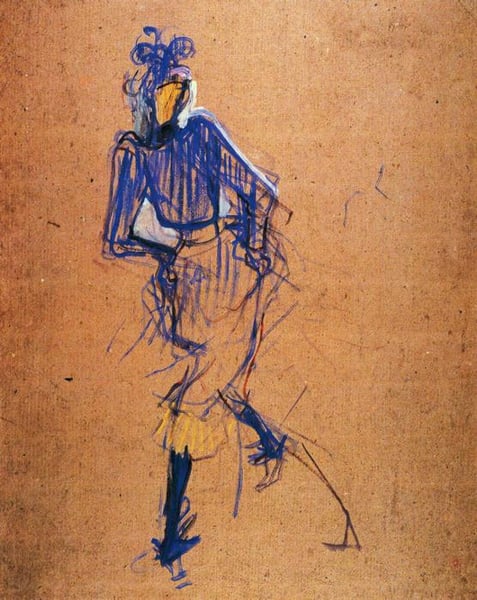
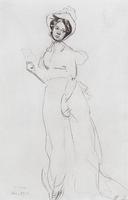
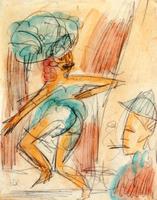
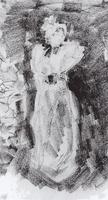
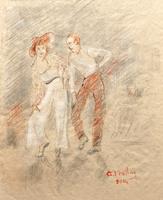
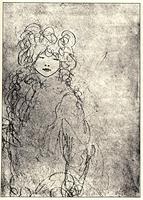
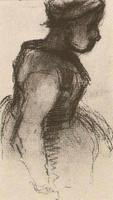
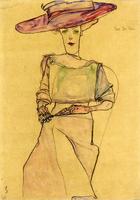
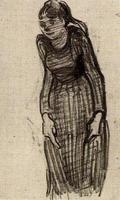
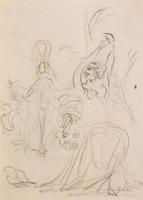
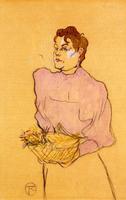
This sketch-study by Henri de Toulouse-Lautrec, Jane Avril Dancing, is a striking example of how the artist distilled the energy of fin-de-siècle Paris into a few bold strokes. Created within the Art Nouveau (Modern) period, the work’s significance lies in its raw immediacy—a quick, dynamic record of motion that feels both spontaneous and meticulously observed.
Toulouse-Lautrec’s approach here is quintessentially modern: he elevates the sketch from mere preparatory tool to a finished statement. The fluid, whip-like contours of Jane Avril’s silhouette—likely inspired by Japanese ukiyo-e prints—typify Art Nouveau’s sinuous line, while the economy of detail focuses all attention on the dancer’s rhythmic pose. Her raised leg, tilted torso, and swirling skirt are captured in a single, continuous gesture, suggesting movement even in a static medium.
As a study, this piece reveals Toulouse-Lautrec’s working method: he observed performers not as posed models but as living organisms of light and shadow. The lack of background or facial features further emphasizes the essence of dance itself—speed, grace, and the visceral thrill of the can-can. This work bridges fine art and commercial poster design, a hallmark of the artist’s career, and anticipates the graphic dynamism of 20th-century illustration. It remains a testament to how a “sketch” can achieve the expressive power of a finished masterpiece.