
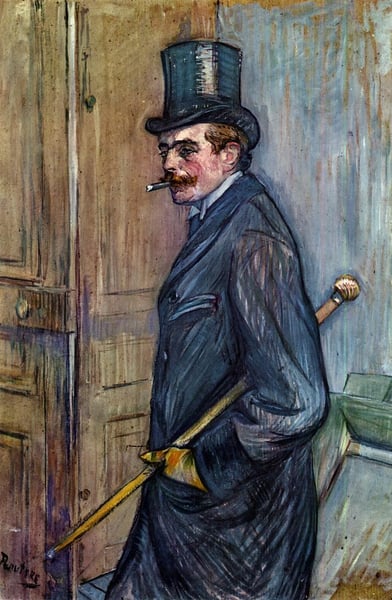
Expert analysis of Henri de Toulouse-Lautrec’s Louis Pascal
Style: Post-Impressionism · Genre: portrait
Expert Art Historical Analysis: "Louis Pascal" by Henri de Toulouse-Lautrec
Henri de Toulouse-Lautrec’s portrait of Louis Pascal stands as a compelling example of Post-Impressionist portraiture, illustrating the artist’s ability to distill character through unconventional means. Created in a period when artists were pushing beyond the naturalism of Impressionism, Toulouse-Lautrec’s work is significant for its fusion of psychological insight with a bold, graphic aesthetic.
Significance within Post-Impressionism:
Toulouse-Lautrec was a key figure in the Post-Impressionist movement, which emphasized subjective expression and formal experimentation over optical accuracy. In this portrait, he employs several hallmarks of the style: a flattened picture plane, strong outlines derived from Japanese ukiyo-e prints, and a restricted yet vibrant color palette. The composition likely eschews traditional symmetry, capturing Louis Pascal in a candid, unidealized moment—a direct departure from the polished, posed portraits of earlier academic painting. This approach aligns Toulouse-Lautrec with contemporaries like van Gogh and Gauguin, who sought to convey inner life through color and line rather than mere likeness.
Why the Portrait Matters:
Toulouse-Lautrec’s portraits are notable for their immediate, almost journalistic honesty. He painted people he knew intimately—friends, performers, and aristocrats of Montmartre—and Louis Pascal was likely a member of his inner circle. The significance of this work lies in its ability to reveal personality through subtle distortions of form and angular, expressive drawing. Toulouse-Lautrec’s use of bold outlines—often thick and sinuous—creates a sense of dynamic tension, while his selective application of color (such as areas of deep red or olive green) heightens the emotional resonance. The artist’s own physical stature and social vantage point gave him a unique ability to capture the psychological complexity of his sitters without sentimentality.
In the broader context of Post-Impressionism, "Louis Pascal" exemplifies the movement’s break from mere visual realism toward a more personal, symbolic, and modern vision of humanity. Toulouse-Lautrec’s portrait remains a testament to his mastery of conveying the essence of a person through the deliberate power of line, color, and composition.
Museum / Gallery
Visually similar
20 works with related composition and palette
Monsieur Louis Pascal
Henri de Toulouse-Lautrec
Henri Dihau
Henri de Toulouse-Lautrec
Friends at the Theatre, Ludovic Halevy and Albert Cave
Edgar Degas
Portrait of M. Paul Sescau (Portrait de M. Paul Sescau)
Henri de Toulouse-Lautrec
Portrait of Leopold Czihaczek, in Profile Facing Left
Egon Schiele
Portrait of the Painter Jensen Hjell
Edvard Munch
Self-portrait
Georg Scholz
Dufy in the Studio
Othon Friesz
Man in a Round Hat (Alphonse Maureau)
Edouard Manet
Portrait of the Comte de Rasty
Giovanni Boldini
Head and Shoulders Portrait
Roderic O'Conor
Vörös Sapkás Férfi
Bela Czobel
Six Friends of the Artist
Edgar Degas
Franz Hauer
Oskar Kokoschka
Portrait of Jean Daurelle
Gustave Caillebotte
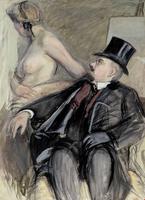
Arne Cederholm Med Modellen
Magnus Enckell
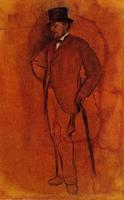
Achille De Gas
Edgar Degas
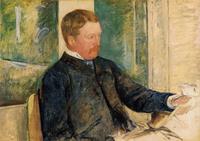
Portrait of Alexander J. Cassatt
Mary Cassatt
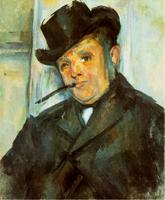
Henry Gasquet
Paul Cezanne
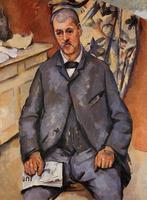
Seated Man
Paul Cezanne