Expert analysis of Edgar Degas’s Six Friends of the Artist
Style: Impressionism · Genre: portrait
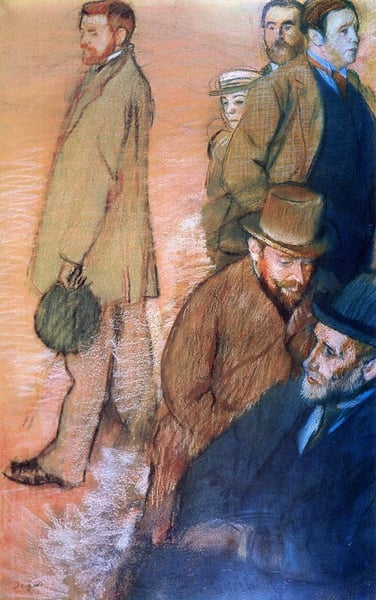
Based solely on the provided facts—that the artwork is Six Friends of the Artist by Edgar Degas, executed in the Impressionist style and belonging to the portrait genre—its significance can be analyzed as follows:
Significance within Impressionism and Portraiture:
First, the very title, Six Friends of the Artist, marks a departure from the formal, commissioned portraits typical of the 19th-century academic tradition. Instead, Degas subverts the genre by focusing on intimate social circles—a hallmark of Impressionist subject matter. The group portrait captures a slice of modern life, emphasizing spontaneity and personal connection over official status.
Second, within the Impressionist style, Degas was known for his innovative approaches to composition, often inspired by photography and Japanese prints. In a group portrait of six figures, this likely translates to asymmetrical cropping, unexpected angles, and a sense of candid interaction rather than stiff posing. The painting would thus feel like a frozen moment in a Parisian gathering, aligning with the Impressionist goal of capturing the fleeting, modern experience.
Third, the significance of this work lies in its characterization of a collective identity. Unlike single portraits that distill one personality, Six Friends of the Artist presents a social dynamic—a network of relationships central to Degas’s own life and to the broader Impressionist community. It reinforces how the movement’s artists often painted their peers (fellow painters, writers, musicians), thereby documenting the very group that was revolutionizing art.
In summary, this portrait is significant because it merges the Impressionist manifesto of modernity with the traditional genre of portraiture, transforming it into a study of social bonds, unconventional composition, and the artist's personal milieu—making it a key example of how Degas and his contemporaries redefined what a portrait could be.
Visually similar
20 works with related composition and palette
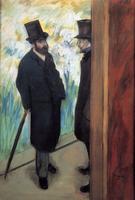
Friends at the Theatre, Ludovic Halevy and Albert Cave
Edgar Degas
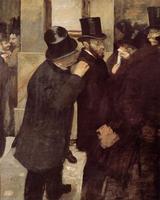
Portraits at the Stock Exchange
Edgar Degas
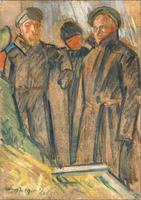
Vaszary János, Katonák, 1915
Vaszary János
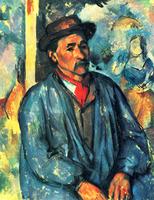
Peasant in a Blue Smock
Paul Cezanne
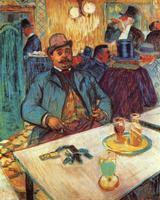
Monsieur Boileau
Henri de Toulouse-Lautrec
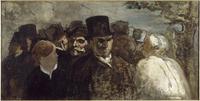
Passers By
Honore Daumier
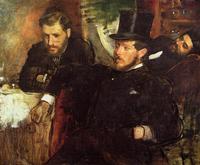
Jeantaud, Linet and Laine
Edgar Degas
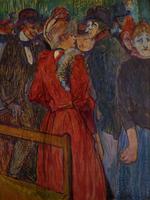
At the Moulin de la Galette
Henri de Toulouse-Lautrec
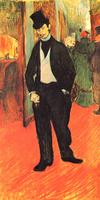
Dr. Tapie Celeyran in a corridor of the French Comedy
Henri de Toulouse-Lautrec
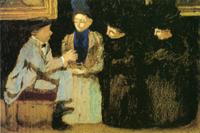
The Discussion
Edouard Vuillard
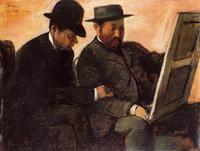
The Amateurs (Paul Lafond and Alhonse Cherfils Examening a Painting)
Edgar Degas
Chez Maxim's
Giovanni Boldini
Brussels students
Jan Toorop
Construction workers
Theophile Steinlen
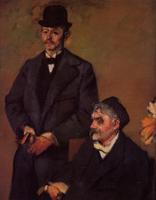
Henri Rouart and His Son Alexis
Edgar Degas
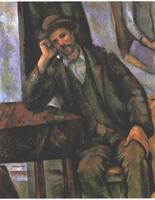
Man Smoking a Pipe
Paul Cezanne
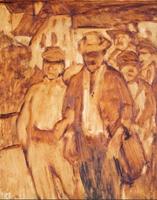
Egry József Munka Után 1911
Egry József
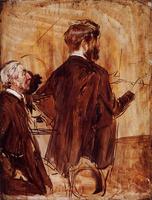
In the Studio
Giovanni Boldini
Self-Portrait
Henri Matisse
Henri Dihau
Henri de Toulouse-Lautrec