
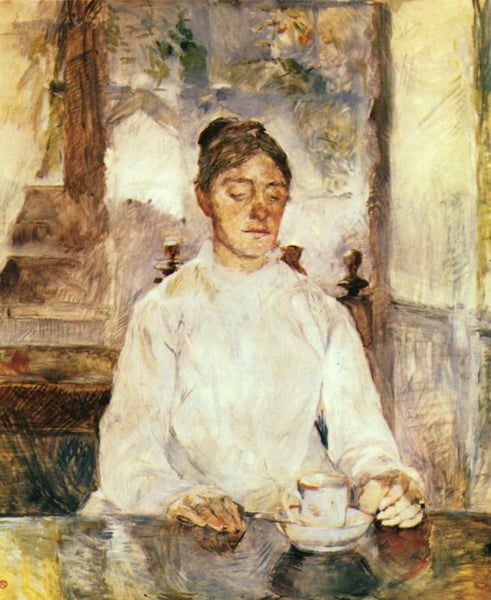
Expert analysis of Henri de Toulouse-Lautrec’s The artist's mother, the Countess Adèle de Toulouse Lautrec at breakfast
Style: Impressionism · Genre: portrait
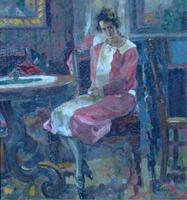
This intimate portrait of the Countess Adèle de Toulouse-Lautrec at breakfast is a revealing example of how Henri de Toulouse-Lautrec applied Impressionist principles to the genre of portraiture. While the artist is more often associated with the cabarets and nightlife of Montmartre, this work demonstrates his ability to capture a private, domestic moment with the same immediacy and sensitivity to light and atmosphere that defined the Impressionist movement.
Significance within Impressionism and portraiture:
-
Everyday modernity: True to the Impressionist ethos, the subject is not posed in a formal, heroic manner but is shown in a routine, unguarded activity—breakfast. This focus on a fleeting, mundane moment elevates the personal and domestic as worthy of fine art, breaking from the grand tradition of official portraiture.
-
Intimate psychological depth: The Countess’s expression and posture suggest a quiet absorption, perhaps reflective or weary. Toulouse-Lautrec, despite his famously complicated relationship with his mother, renders her with a tenderness that avoids sentimentality. The loose brushwork and softened edges—hallmarks of Impressionist technique—convey not just visual reality but an emotional atmosphere of private stillness.
-
Light and color as narrative: The painting likely uses natural daylight filtering through a window (a common Impressionist device) to define the scene. Warm, muted tones dominate the palette, emphasizing the morning setting and the calm of the interior. The breakfast table, with its simple objects, becomes a still-life within the portrait, grounding the figure in her domestic environment.
-
Artist’s personal context: This portrait is significant as a rare, unguarded glimpse of the artist’s own mother, whose aristocratic dignity and devotion contrast sharply with the bohemian world Lautrec would later depict. It reveals his mastery of capturing character through environment—an Impressionist innovation that allowed the setting to speak as loudly as the sitter’s face.
In essence, this work stands as a quiet masterpiece of Impressionist portraiture: a confluence of family biography, painterly spontaneity, and the movement’s revolutionary interest in the poetry of everyday life.
Museum / Gallery
Visually similar
20 works with related composition and palette
Portrait of a Lady
Rik Wouters
Portrait of Margaryta Murashko
Oleksandr Murashko
Portrait of Elizabeth van Rysselberghe, Seated with Her Hands on the Table
Theo van Rysselberghe
Madame Cezanne in Blue
Paul Cezanne
Young Girl Resting
Berthe Morisot
Portrait of the Artist's Wife
Samuel Peploe
Edith Blaney (Mrs. Dwight Blaney)
Childe Hassam
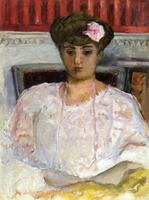
Misia with a Pink Corsage
Pierre Bonnard
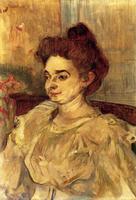
Mademoiselle Beatrice Tapie de Celeyran
Henri de Toulouse-Lautrec
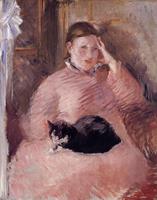
Woman with a Cat
Edouard Manet
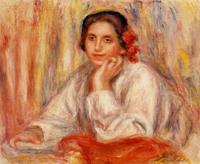
Vera Sertine Renoir
Pierre-Auguste Renoir
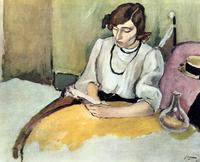
Portrait of Hermine David
Jules Pascin
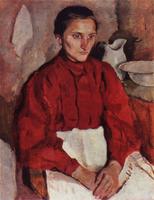
Portrait of a nurse
Zinaida Serebriakova
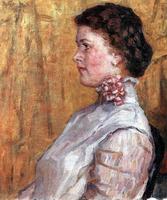
Portrait of woman with yellow background
Vasily Surikov
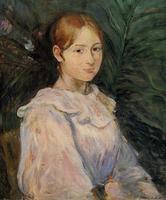
Bust of Alice Gamby
Berthe Morisot
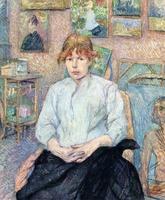
The Redhead with a White Blouse
Henri de Toulouse-Lautrec
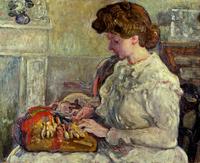
The Lacemaker
Louis Valtat
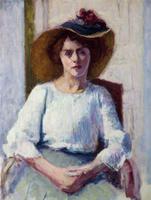
Woman in White
Roderic O'Conor
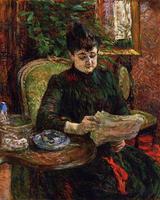
Madame Aline Gibert
Henri de Toulouse-Lautrec
Female Figure in the Interior
Adalbert Erdeli