
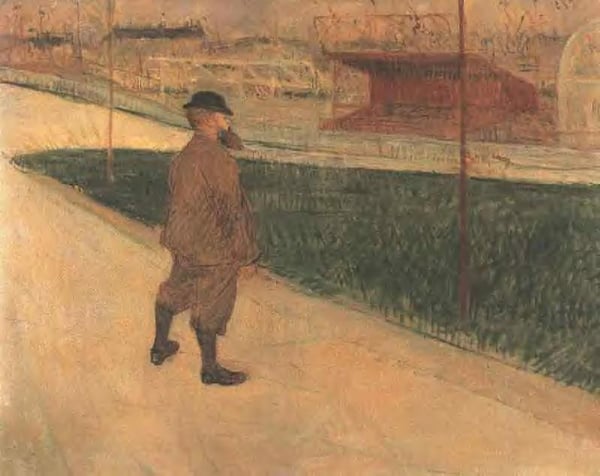
Expertenanalyse zu Henri de Toulouse-Lautrecs Tristan Bernard at the Buffalo Station
Stil: Art Nouveau (Modern), Post-Impressionism · Genre: genre painting
Analysis of "Tristan Bernard at the Buffalo Station" by Henri de Toulouse-Lautrec
As a genre painting that fuses Post-Impressionism with Art Nouveau (Modern) aesthetics, this work captures a fleeting, unposed moment of modern urban life—a hallmark of Toulouse-Lautrec's genius. The piece is significant for several reasons:
-
Candid Modernity: Toulouse-Lautrec elevates a mundane, transient scene—a figure waiting at a station—into a psychologically charged portrait. This aligns with Post-Impressionism's break from naturalism, favoring emotional and subjective experience over mere optical accuracy. The choice of a contemporary setting (the Buffalo Station) reflects the artist's fascination with the rhythms of fin-de-siècle Parisian society.
-
Art Nouveau Decorative Line: The composition likely employs the sinuous, expressive contours and flattened planes characteristic of Art Nouveau. Toulouse-Lautrec often used such decorative stylization to compress space and emphasize the silhouette of his subject, bridging fine art and commercial poster design. This work exemplifies how he transformed everyday observation into a graphic, modernist statement.
-
Psychological Depth Through Gesture: True to Post-Impressionist concerns, the painting prioritizes inner character over physical likeness. Tristan Bernard, the writer-critic and friend of the artist, is depicted in a moment of waiting—a posture that conveys distraction, boredom, or anticipation. Toulouse-Lautrec’s ability to capture this transient state of mind makes the work a poignant study of modern isolation and stillness within movement.
-
Interplay of Genres: As a genre painting, it documents a real social type (the commuter or traveler) rather than a mythological or allegorical figure. Yet, by applying the stylized flatness of Art Nouveau and the emotional resonance of Post-Impressionism, Toulouse-Lautrec elevates this genre scene into a landmark of modernist portraiture—a testament to his role in democratizing subject matter while pushing formal boundaries.
Museum / Gallery
Visuell ähnlich
20 Werke mit ähnlicher Komposition und Farbpalette
The National Game
Arthur Streeton
Landstrasse
Varlin
Landscape in Autumn
Gustave Loiseau
Scehiber Hugó, Tűz 1922
Scheiber Hugó
The Velodrome
Paul Signac
The Clearing
Camille Pissarro
Landscape with Figure
Joaquín Sorolla
Study on the Island
Georges Seurat
Un Paseo en el Parque
Armando Reveron
Road near the canal
Johan Hendrik Weissenbruch
Pere Magloire on the Road to Saint-Clair, Etretat
Gustave Caillebotte
The Road to Gennevilliers
Paul Signac
Landscape
Louis Abel-Truchet
The Wellington Racecourse in Drizzle (Ostende)
Alfred William Finch
Valhermeil near Oise, Rain effect
Camille Pissarro
Study for 'The Parade of Dogs at Wembley'
Algernon Talmage
White dog
Georges Seurat
Winter landscape
Cuno Amiet
Winter, Central Park
Childe Hassam
Woman Fishing and Seated Figures
Georges Seurat