Winter landscape
Expertenanalyse zu Cuno Amiets Winter landscape
Stil: Post-Impressionism · Genre: landscape
Expert Analysis of "Winter Landscape" by Cuno Amiet
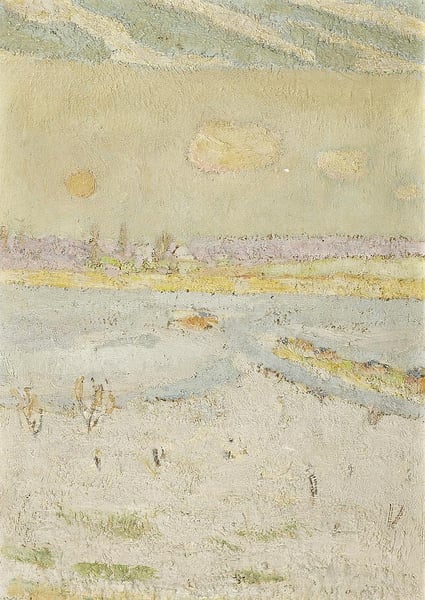
Cuno Amiet’s Winter Landscape exemplifies the core ambitions of Post-Impressionism: moving beyond objective observation to convey emotional and symbolic resonance through color, form, and texture. As a Swiss painter who later transitioned toward Expressionism, Amiet here shows how winter becomes a vehicle for subjective experience, rather than mere atmospheric recording.
Significance within Post-Impressionism:
Unlike Impressionist snow scenes that prioritize transient light and atmospheric effects (e.g., Monet’s grain stacks in snow), Amiet employs bold, non-naturalistic color and simplified, rhythmic forms to evoke a heightened emotional state. The landscape is stripped of anecdotal detail; snow-covered fields, skeletal trees, and a low horizon become almost abstract patterns. This aligns with Post-Impressionist principles of synthesizing nature into a personal, decorative vision—influenced by Gauguin’s Cloisonnism and van Gogh’s expressive brushwork.
Technical and Stylistic Choices:
- Color: Swaths of cool violets, deep blues, and muted whites are punctuated by warm accents (perhaps ochre or orange in tree trunks or sky), creating a chromatic tension that “feels” cold yet vibrant—emotionally charged rather than scientifically accurate.
- Brushwork: Visible, often thickly applied strokes impart a tactile quality. The paint surface becomes an active element, mirroring the artist’s engagement with the scene.
- Composition: A flattened perspective, with large masses of white and blue pushing against each other, gives the work a decorative, almost tapestry-like flatness—eschewing traditional depth for symbolic space.
Cultural and Artistic Context:
Amiet was a pivotal figure in Swiss modernism, bridging late 19th-century Post-Impressionism and early 20th-century Expressionism (he was a founding member of Die Brücke in 1905, though his style remained more lyrical). Winter Landscape embodies this transitional moment: it retains the Post-Impressionist focus on a meaningful, structured nature while anticipating the heightened emotional intensity of Expressionist color.
Conclusion:
The work’s significance lies in how Amiet transforms a conventional winter motif into a deeply personal, formally ambitious image. It demonstrates that Post-Impressionism was not a single style but a set of attitudes—here, the winter landscape becomes a mental and emotional construct, where snow is not merely snow but a symbol of isolation, stillness, or even spiritual renewal. Amiet’s synthesis of color, form, and feeling makes this a quintessential Post-Impressionist landscape, stepping confidently toward modernity.
Visuell ähnlich
20 Werke mit ähnlicher Komposition und Farbpalette
Landscape with full moon
Jan Sluyters
The away Samson in Grandcamp
Georges Seurat
The Riverbanks
Georges Seurat
Winter on the Seine, Lavacourt
Claude Monet
Valhermeil near Oise, Rain effect
Camille Pissarro
Zonnegloed
Emile Claus
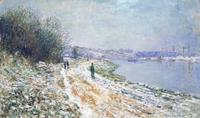
The Tow Path at Argenteuil, Winter
Claude Monet
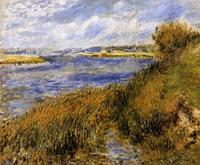
The Banks of the Seine at Champrosay
Pierre-Auguste Renoir
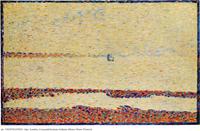
Beach at Gravelines
Georges Seurat
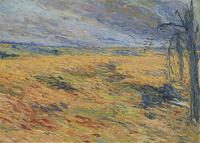
Windward
Henri Martin
The fishing fleet of Veere
Jan Toorop
Banks of the Seine at Champrosay
Pierre-Auguste Renoir
Landscape of Vexin
Louis Hayet
Stormy Weather, Pas de Calais
Camille Corot
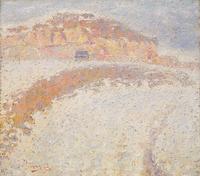
Kamnitnik
Ivan Grohar
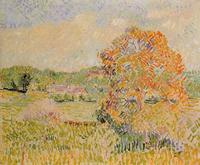
Springtime at Eragny (study)
Camille Pissarro
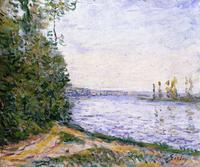
The Seine near By
Alfred Sisley
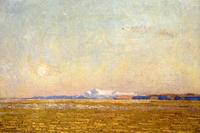
Moonrise at Sunset, Harney Desert
Childe Hassam
St. Malo
Maurice Prendergast
Crescent Beach (also known as Crescent Beach, St. Malo)
Maurice Prendergast