
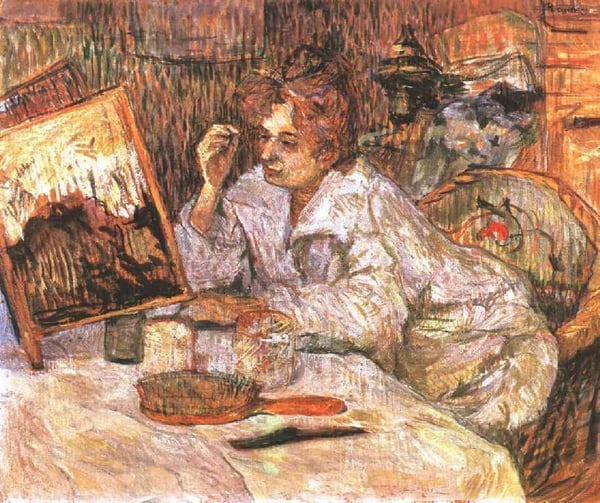
Analisi esperta di Woman at Her Toilette di Henri de Toulouse-Lautrec
Stile: Post-Impressionism · Genere: genre painting
Expert Analysis: "Woman at Her Toilette" by Henri de Toulouse-Lautrec
Henri de Toulouse-Lautrec’s Woman at Her Toilette is a quintessential example of Post-Impressionist genre painting, distinguished not by grand historical narrative but by an unflinching, intimate glimpse into private, everyday life. The work belongs to a series of toilette scenes that Toulouse-Lautrec produced in the mid-1890s, reflecting his deep engagement with the unguarded moments of women—often prostitutes or working-class figures—whom he portrayed without sentimentality or moral judgment.
Significance within Post-Impressionism and Genre Painting
-
Psychological Intimacy and Candid Observation
Toulouse-Lautrec drew inspiration from Edgar Degas’s similar scenes of bathers and women at their toilette, but he pushed further into raw, psychological territory. The woman is absorbed in her own world, her back partially turned, her posture unselfconscious. This viewpoint—as if the viewer has intruded on a private ritual—creates a sense of immediacy and psychological depth that elevates the mundane act of grooming into a study of human vulnerability. -
Bold, Synthetic Color and Line
Characteristic of Post-Impressionism, Toulouse-Lautrec eschews naturalistic modeling in favor of expressive, almost graphic flatness. He employs strong outlines (influenced by Japanese ukiyo-e prints and contemporary poster art) and patches of unmodulated color—warm ochres, deep violets, cool whites—that define form through contrast rather than shading. The juxtaposition of the woman’s pale skin against the rich, dark background concentrates attention on her flesh and the ritualistic gesture of her hands. -
Unconventional Composition
The asymmetrical cropping and tilted perspective owe a debt to Degas and to photography, but Toulouse-Lautrec makes them his own. The figure is pushed to the side, often cut by the picture’s edge, while the space itself feels compressed and slightly claustrophobic. This framing—unbalanced yet deliberate—mirrors the off-center, often marginalized lives of the women he portrayed, while also asserting a modern, anti-academic compositional sensibility. -
Embodiment of the “Fin de Siècle” Spirit
As a genre painting, Woman at Her Toilette captures the late 19th-century interest in the private sphere and the psychology of Parisian women. Toulouse-Lautrec’s work stands apart from the idealized or moralizing genre scenes of earlier 19th-century art. Instead, he presents a matter-of-fact, almost diary-like realism that aligns with the broader Symbolist and Post-Impressionist fascination with interiority and the hidden truths of modern life.
Conclusion
This artwork is significant because it transforms a quotidian private moment into a powerful statement of Post-Impressionist aesthetics: unflinching observation, formal daring, and a rejection of idealization. Toulouse-Lautrec’s ability to merge the intimacy of genre painting with the expressive modernism of his color, line, and composition makes Woman at Her Toilette a seminal work that bridges late 19th-century realism and the more subjective, psychological art of the 20th century.
Museum / Gallery
Visivamente simili
20 opere con composizione e palette affini
The Toilet Ms. Fabre
Henri de Toulouse-Lautrec
Madame Poupoule at Her Dressing Table
Henri de Toulouse-Lautrec
Portrait of a Lady
Rik Wouters
Hangover
Henri de Toulouse-Lautrec
Lenna Painting (The Artist's Daughter)
William James Glackens
Woman in Profile
Alfred William Finch
Rice Powder
Henri de Toulouse-Lautrec
The Last Crumbs (In The Restaurant La Mie)
Henri de Toulouse-Lautrec
Childrens' Room
Nicolae Tonitza
Prostitutes Around a Dinner Table
Henri de Toulouse-Lautrec
At the Coffee Table
Edvard Munch
Two in a chair
Konstantin Korovin
Little Girl with a Cat
Pierre Bonnard
La Repasseuse
Maximilien Luce
The artist's mother, the Countess Adèle de Toulouse Lautrec at breakfast
Henri de Toulouse-Lautrec
Woman Reading
Henry van de Velde
Paul, Study
Camille Pissarro
Interior with a Girl Reading
Henri Matisse
Reading Woman In Violet Dress
Henri Matisse
In the bar "Le Bouchon"
Edouard Manet