Expert Analysis: "Yvette Guilbert Taking a Curtain Call" by Henri de Toulouse-Lautrec
As a sketch and study from the Art Nouveau (Modern) period, this work exemplifies Toulouse-Lautrec’s incisive ability to distill movement and personality into swift, expressive lines. Its significance lies in three key aspects:
-
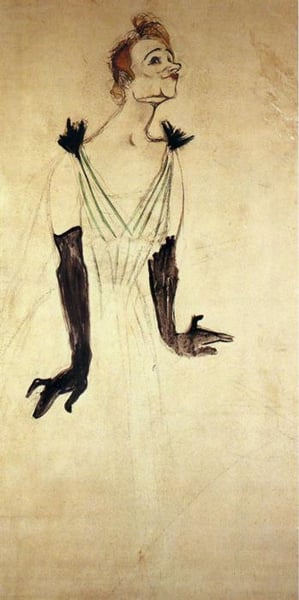
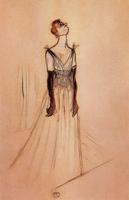
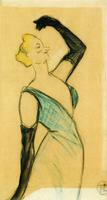
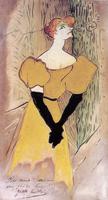
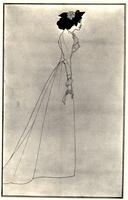
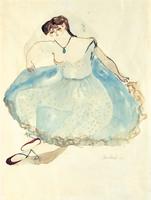
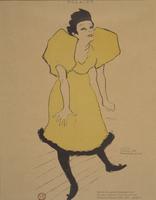
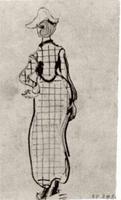
Capturing the Ephemeral Performance: Toulouse-Lautrec’s sketch freezes a fleeting theatrical moment—the curtain call—with remarkable economy. The artist strips away extraneous detail, focusing on the dynamic posture of the celebrated cabaret singer Yvette Guilbert. This aligns with Art Nouveau’s fascination with capturing the energy of modern urban life, particularly the spectacle of Parisian nightlife.
-
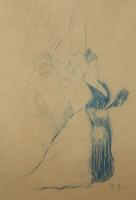
The Power of the Study: As a study, the work reveals Toulouse-Lautrec’s working process—how he observed his subjects live, translating their gestures into a few confident strokes. This rawness gives the piece an immediacy that finished portraits often lack, offering a direct window into the artist’s hand and eye.
-
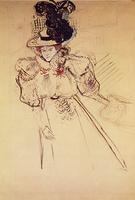
Stylistic Bridge to Art Nouveau: Though primarily a realist observer, Toulouse-Lautrec’s flattened forms, curved contours, and emphasis on silhouette here prefigure Art Nouveau’s sinuous linearity. The elongated, almost caricatured proportions of Guilbert’s figure (notably her famous long gloves and hat) echo the decorative linear rhythms that define the style, while still maintaining the psychological charge of a candid moment.
In essence, this sketch is significant for how it marries reportorial spontaneity with the decorative elegance of Art Nouveau, making a simple curtain call into an iconic study of persona and performance.