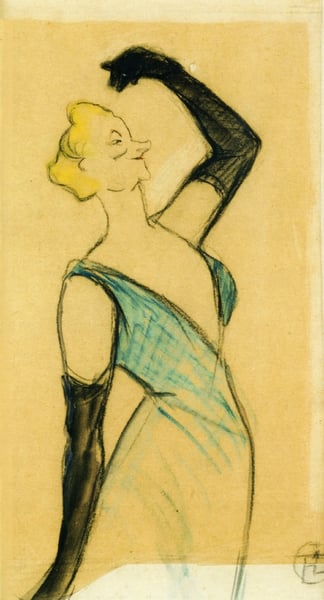
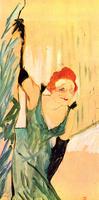
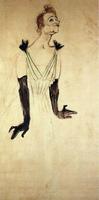
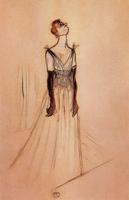
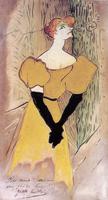
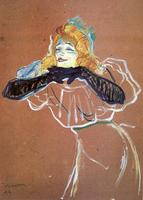
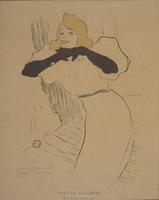
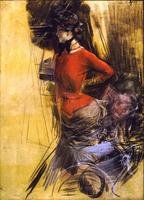
This portrait of Yvette Guilbert by Henri de Toulouse-Lautrec is a striking example of Art Nouveau’s embrace of modern life, fused with the artist’s signature psychological insight. Painted in the 1890s, it captures the celebrated cabaret singer in a characteristically performative pose, her elongated figure and dramatic black gloves—her trademark—becoming almost abstract graphic elements. Toulouse-Lautrec’s use of flat, unmodulated color areas and sinuous, calligraphic outlines owes a clear debt to Japanese ukiyo-e prints, a key influence on Art Nouveau’s decorative line.
What makes this work significant is its role in elevating the portrait of a popular entertainer to high art, reflecting the bohemian culture of Montmartre. Unlike idealized portraits of the era, Toulouse-Lautrec emphasizes Guilbert’s gaunt features, sharp profile, and theatrical mannerisms without flattery, yet with immense respect for her stage persona. The slight tilt of her head and the stark contrast between the black costume and pale face create a tension between intimacy and public spectacle. This piece not only documents a star of the Parisian demimonde but also exemplifies how Art Nouveau—often associated with decorative objects—could be a vehicle for modernist portraiture, anticipating the expressive distortions of later 20th-century art.