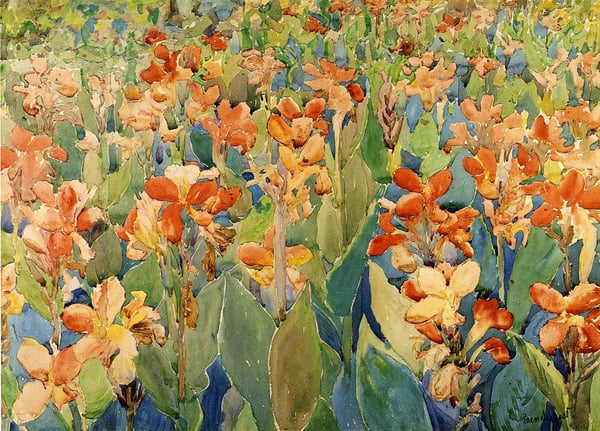
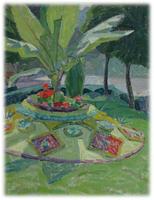
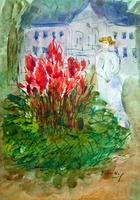
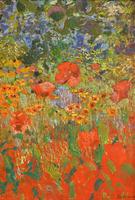
Maurice Prendergast’s Bed of Flowers (also known as Cannas or The Garden) is a defining example of American Post-Impressionism, notable for its radical departure from naturalistic representation in favor of decorative patterning and rhythmic color. Painted in the early 1910s, the work reflects Prendergast’s exposure to French modernists—particularly the Fauves and Cézanne—yet transforms their lessons into a distinctly personal vision.
What makes it significant within its style:
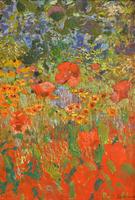
Prendergast treats the flower bed not as a literal botanical study but as a tapestry of interlocking, jewel-toned forms. The canvas is densely packed with broad, flat patches of red, orange, green, and blue, applied in a mosaic-like technique that flattens space and emphasizes surface pattern. This approach aligns with Post-Impressionism’s move toward subjective expression, but Prendergast pushes further by eliminating traditional perspective and modeling. The figures—likely strolling women amid the blooms—are reduced to silhouettes, integrated into the overall fabric of the garden.
Within the genre of flower painting (often consigned to decorative or minor status), Prendergast elevates the subject to a symphonic arrangement of color and motion. He anticipates later modernist abstraction while retaining a joyous, lyrical quality. The painting’s significance also lies in its role as a bridge: it demonstrates how American artists absorbed European avant-garde ideas (especially the emphasis on pure color and two-dimensional design) and applied them to intimate, everyday scenes, thereby asserting a new, boldly modern identity for American art.