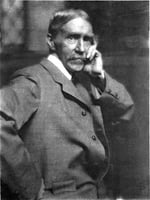
Analyse experte de Gloucester Park de Maurice Prendergast
Style : Naïve Art (Primitivism) · Genre : genre painting
Expert Analysis: "Gloucester Park" by Maurice Prendergast
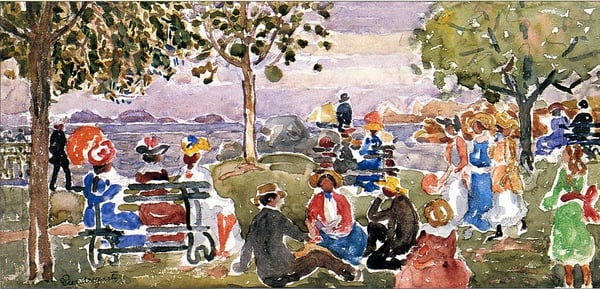
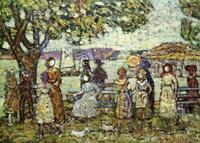
Maurice Prendergast’s Gloucester Park stands as a vibrant exemplar of Naïve Art (often termed Primitivism) within the genre of modern leisure painting. Created during a period when Prendergast was deeply influenced by the Post-Impressionist experiments of Cézanne and the decorative flatness of Japanese ukiyo-e prints, the work captures a sun-drenched, bustling park scene with a deliberate, childlike simplicity that belies its sophisticated composition.
Significance within the Naïve/Primitivist Style
What makes Gloucester Park significant is Prendergast’s radical departure from academic naturalism. He reduces figures, trees, and pathways to blocky, almost geometric shapes, arranged in rhythmic patterns that recall tapestry or mosaic. The colors are high-key and unmodulated—bright greens, blues, reds, and whites—applied in short, dabbing strokes that create a shimmering, decorative surface. This flattening of space and rejection of deep perspective aligns with the Primitivist desire to recapture a “pure,” untutored vision, free from the conventions of Renaissance perspective. Prendergast’s figures are simplified into animated silhouettes, their gestures and groupings emphasizing the communal joy of a Sunday outing rather than individual portraiture.
Significance within Genre Painting
As a genre scene, Gloucester Park documents early 20th-century American leisure culture, specifically the public parks of the coastal town of Gloucester, Massachusetts. Prendergast was a member of the progressive group “The Eight,” but unlike many of his contemporaries who focused on gritty urban realism, he specialized in idyllic, crowd-filled parks and beaches. This painting elevates the ordinary moment—strolling, sitting, children playing—into a timeless, almost ritualistic celebration of modernity. The composition is crowded but never chaotic; Prendergast uses repetition of forms (parasols, hats, benches) to create a syncopated rhythm that suggests music and movement.
Art-Historical Context
Prendergast’s work bridges American Impressionism and early Modernism. Gloucester Park is especially important because it demonstrates how Naïve Art could be a vehicle for sophisticated formal innovation. The artist’s deliberate awkwardness—the oddly proportioned figures, the lack of atmospheric depth—was a conscious rejection of academic polish in favor of emotional directness and decorative unity. This places Prendergast ahead of his time, anticipating the Fauves’ bold color and the Cubists’ flattening of space, while remaining uniquely American in its celebration of public leisure.
In summary, Gloucester Park is significant for its masterful synthesis of Primitivist simplicity and Post-Impressionist structure, turning a casual genre scene into a vibrant, patterned meditation on modern life. It stands as a cornerstone of Prendergast’s mature style and a key work in the American Naïve tradition.
Visuellement similaire
20 œuvres à la composition et à la palette proches
Salem Harbor No. 1
Maurice Prendergast
The Pavilion
Maurice Prendergast
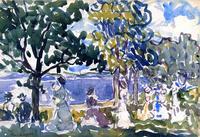
Beach Promenade
Maurice Prendergast
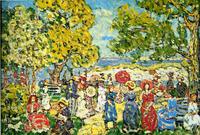
Landscape with Figures
Maurice Prendergast
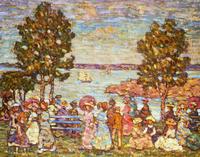
The Holiday (also known as Figures by the Sea or Promenade by the Sea)
Maurice Prendergast
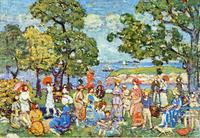
The Promenade
Maurice Prendergast
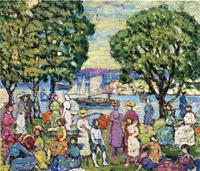
Gloucester Harbor
Maurice Prendergast
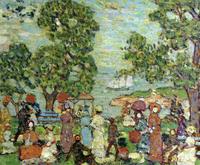
Park Scene NeBay
Maurice Prendergast
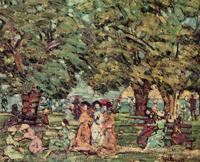
Under the Trees
Maurice Prendergast
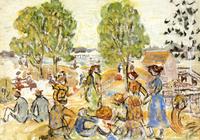
Picnic
Maurice Prendergast
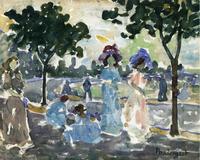
Road to the Shore
Maurice Prendergast
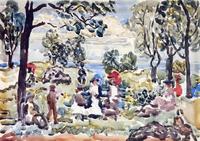
Park, Gloucester
Maurice Prendergast
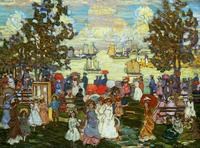
Salem Willows (also known as The Promenade, Salem Harbor)
Maurice Prendergast
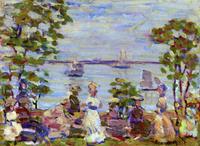
Seaside Picnic
Maurice Prendergast
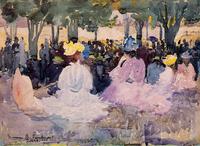
Figures on the Grass
Maurice Prendergast
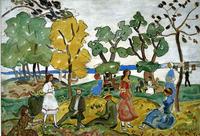
Picnic
Maurice Prendergast
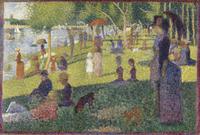
Study for A Sunday on La Grande Jatte
Georges Seurat
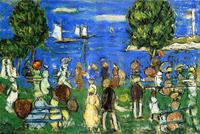
Promenade Salem
Maurice Prendergast
Seashore
Maurice Prendergast
Beach Scene No. 4
Maurice Prendergast