Analisi esperta di The Painter's Mother III di Lucian Freud
Stile: Expressionism · Genere: portrait
Expert Analysis of Lucian Freud's The Painter's Mother III
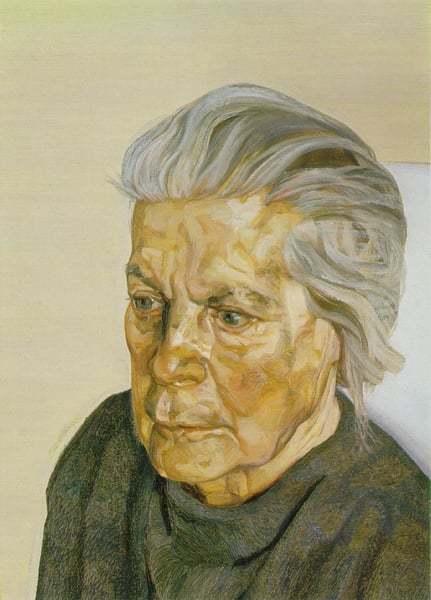
Lucian Freud’s The Painter’s Mother III (c. 1972–73) stands as a masterwork of Expressionist portraiture, distinguished by its unsparing psychological intensity and technical bravura. Painted late in his career, this work belongs to a series of portraits Freud made of his elderly mother, Lucy Freud, who became a central subject after the death of her husband, Ernst Freud.
Significance within Expressionism
Freud’s approach here epitomizes the Expressionist commitment to rendering inner truth over внешняя likeness. The canvas is dominated by thick, coruscating layers of oil paint—what the artist called “flesh as matter”—that seem to pulse with visceral energy. The mother’s face is modeled through aggressive, almost sculptural brushstrokes, with pale whites, grays, and muted ochres suggesting pallor and fragility. Her eyes, half-lidded and unfocused, convey a retreat into private thought, while the loose, sagging skin of her neck and hands bears the brutal evidence of aging. This is not a sentimental portrait; it is an unflinching meditation on mortality, vulnerability, and the complex bond between artist and sitter.
Genre Innovation
Freud subverts conventional portraiture by elevating the mundane moment into a monumental statement. The composition is starkly simple: his mother is seated in her London home, swathed in a woolen coat, her hands resting passively in her lap. Yet the dense, close-up cropping and the harsh, relentless light (often provided by a single, bare bulb) create a sense of theatrical immediacy. The background, rendered in vague, smeared strokes, dissolves into abstraction, forcing all attention onto the human figure. This technique—blurring the boundary between figure and ground—echoes the Expressionist interest in subjective, emotional space.
Legacy and Context
The Painter’s Mother III is particularly significant for how it exemplifies Freud’s late-career shift toward an even more raw, corporeal realism. Unlike the polished surfaces of his early work, this portrait’s impastoed surface and deliberate awkwardness (the slight asymmetry of the face, the unresolved edges) invest the painting with a sense of struggle—both the struggle of the aging body and the struggle of the artist to capture it. It forms a poignant counterpart to Freud’s earlier, more explicitly Freudian portraits of his mother, but here the psychological weight is borne entirely by the paint itself. In this, the work anticipates the extreme physicality of his later nudes and remains a landmark of late 20th-century portraiture, reminding viewers that expressionism’s greatest power lies in honesty, not sentiment.
Museum / Gallery
Visivamente simili
20 opere con composizione e palette affini
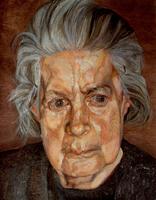
The Painter's Mother II
Lucian Freud
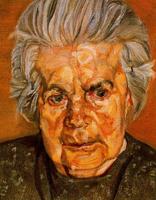
The Painter's Mother
Lucian Freud
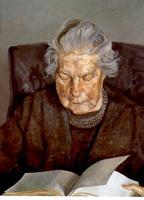
The Painter's Mother Reading
Lucian Freud
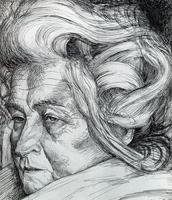
The Mother
Umberto Boccioni
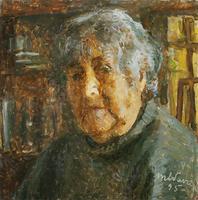
Self Portrait
Tetyana Yablonska
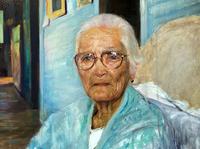
First Visit
Luis Álvarez Roure
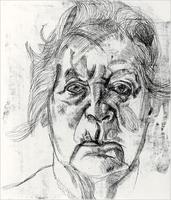
The Painter's Mother
Lucian Freud
The portait of old bolshevik Berberyan
Mariam Aslamazian
Portrait of Mother
Kazimir Malevich
Self-Portrait
Kathe Kollwitz
Portrait of Mila Skukan (born Dobrosavljević) alla prima
Alfred Freddy Krupa
The Artist's Mother
Luis Álvarez Roure
Portrait of Dorrit Black
Jacqueline Hick
Winston Churchill
Graham Sutherland
Aline
Lucian Freud
The venerable old woman of the mountain
Antonio Sicurezza
Portrait of Shtitelman Fanna
Petros Malayan
Mila Skukan
Alfred Freddy Krupa
Self-portrait
Anatoli Papian
Artist's Father
Mehram Sheikholeslami