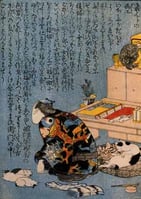
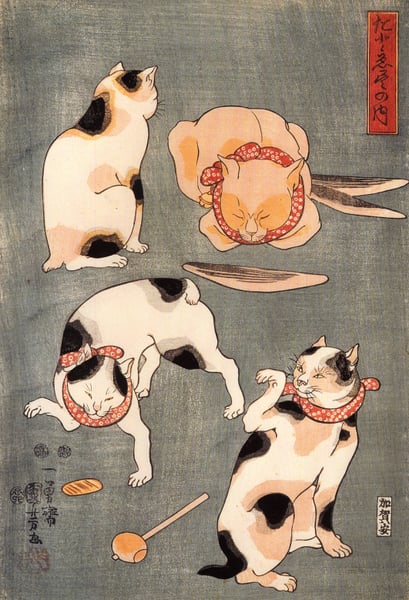
Four cats in different poses
Expertenanalyse zu Utagawa Kuniyoshis Four cats in different poses
Stil: Ukiyo-e · Genre: animal painting
As an expert art historian, I will analyze "Four cats in different poses" by Utagawa Kuniyoshi within the context of the Ukiyo-e style and the animal painting genre, focusing solely on the provided facts.
Ukiyo-e, or "pictures of the floating world," traditionally depicted scenes of everyday life, kabuki actors, and landscapes. However, within this genre, animal paintings—particularly of cats—occupied a unique niche. Kuniyoshi was a master of the Ukiyo-e style, renowned for his dynamic compositions and imaginative subjects, and his feline studies are among the most celebrated in the tradition.
The significance of "Four cats in different poses" lies in its demonstration of Kuniyoshi’s ability to elevate a seemingly simple domestic subject into a work of graphic power and observational wit. The title itself, focusing on "different poses," is key. In Ukiyo-e, the depiction of animals often carried symbolic or humorous undertones, but here Kuniyoshi appears to be conducting a formal study of feline behavior and anatomy through the lens of the woodblock print.
By presenting four distinct poses—likely capturing the cat's characteristic movements, stretches, or moments of alertness—Kuniyoshi achieves several notable effects:
-
Variety and rhythm: The multiple poses create a serial, almost cinematic visual rhythm, a hallmark of Ukiyo-e print series. This allows the viewer to appreciate the cat's range of expression, from tense stillness to languid relaxation.
-
Line and silhouette: The Ukiyo-e style emphasizes bold outlines and flat areas of color. In an animal painting, these lines must convey form and movement with great economy. Kuniyoshi’s skill in rendering the cat’s curved back, tail positions, and angular head shapes through simple, elegant lines makes each pose both anatomically plausible and artistically stylized.
-
Genre innovation: While Kuniyoshi is best known for his warrior prints (musha-e) and ghost scenes, his cat paintings are significant for bringing the animal painting genre into the mainstream Ukiyo-e canon. They show that Ukiyo-e could be a vehicle for pure, charming naturalism without sacrificing the bold graphic sense of the style.
In essence, "Four cats in different poses" is significant because it exemplifies Kuniyoshi’s virtuosity within the Ukiyo-e animal painting tradition: it transforms a common domestic subject into a studied, rhythmic composition that celebrates the cat's iconic form while demonstrating the expressive potential of the woodblock medium.
Visuell ähnlich
20 Werke mit ähnlicher Komposition und Farbpalette
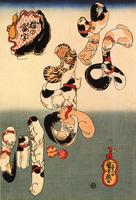
Cats forming the caracters for catfish
Utagawa Kuniyoshi
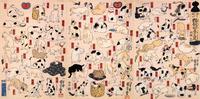
Cats suggested as the fifty three stations of the Tokaido
Utagawa Kuniyoshi
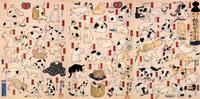
55 cats representing the 53 stations of the Tokaido
Utagawa Kuniyoshi
Cat
Hishida Shunso
One Hundred Dogs
Ito Jakuchu
狸猫图
Qian Xuan
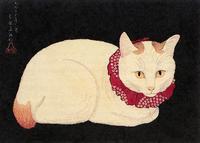
Tama
Shotei Takahashi
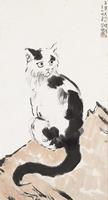
Cat
Xu Beihong
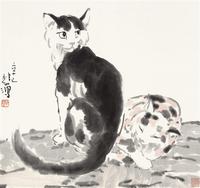
Two Cats
Xu Beihong
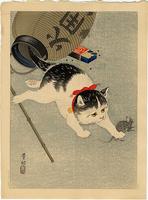
Cat Catching a Mouse
Ohara Koson
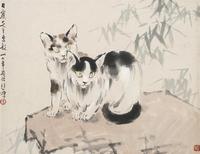
Cats on Rock
Xu Beihong
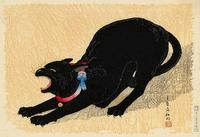
Cat with Bell
Shotei Takahashi
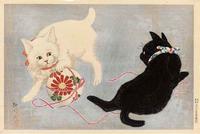
Cats with Ball
Shotei Takahashi
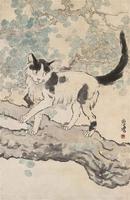
Cat
Xu Beihong
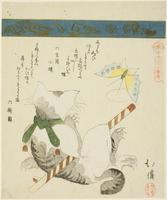
Cat Playing with a Toy Butterfly
Toyota Hokkei
Walking cat
Theophile Steinlen
Cat and Kittens
Kiyoshi Saito
Cat
Alfred Freddy Krupa
Kitten with Butterfly
Xu Beihong
Cat
Xu Beihong