Analisi esperta di One Hundred Dogs di Ito Jakuchu
Stile: Ukiyo-e · Genere: animal painting
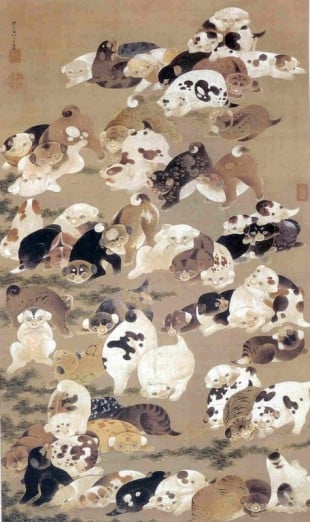
Analysis of "One Hundred Dogs" by Ito Jakuchu
Ito Jakuchu’s “One Hundred Dogs” stands as a remarkable and somewhat atypical work within the Ukiyo-e tradition. While Ukiyo-e is best known for its depictions of the “floating world”—courtesans, kabuki actors, and landscapes—Jakuchu, an 18th-century master, consistently defied easy categorization. This painting elevates a seemingly simple animal subject into a tour de force of observational prowess and artistic innovation.
The work’s primary significance lies in its radical departure from the stylized, often flat decorative quality common to many Ukiyo-e compositions. Instead, Jakuchu infuses “One Hundred Dogs” with a startling degree of naturalism and individual characterization. Each of the hundred dogs is meticulously rendered, with distinct poses, coat textures, and expressions. This attention to detail—from the sheen of a sleeping puppy’s fur to the alert posture of a hunting hound—demonstrates Jakuchu’s deep study of animal anatomy and behavior, a practice influenced by both Chinese bird-and-flower painting and early glimpses of Western realism.
The compositional structure is equally impressive. Jakuchu orchestrates a teeming, lively crowd across a horizontal scroll or screen, using subtle variations in scale, overlapping forms, and directional gazes to create visual rhythm. The dogs interact in a playful, almost human-like social dynamic: some roughhouse, others nap, and a few stare outward, directly engaging the viewer. This anthropomorphic touch adds a layer of narrative charm, but it never undermines the authentic animality of the subjects.
Furthermore, the work exemplifies Jakuchu’s technical mastery. His brushwork varies from precise, fine lines for whiskers and claws to softer, ink-wash-like passages for massed bodies. He employs a restrained yet rich palette—ochres, grays, blacks, and warm whites—that avoids gaudiness and instead grounds the scene in a natural, earthy harmony. Through these choices, “One Hundred Dogs” transcends its genre as mere animal painting to become both a scientific study and a poetic meditation on vitality and multiplicity.
In the context of Ukiyo-e, Jakuchu’s “One Hundred Dogs” is significant as a testament to an artist who pushed the boundaries of his medium. It showcases a singular vision that fused Eastern compositional elegance with Western-inspired observation, creating work that feels strikingly modern in its empathetic, character-driven approach to the natural world.
Visivamente simili
20 opere con composizione e palette affini
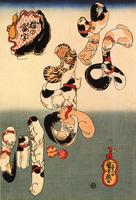
Cats forming the caracters for catfish
Utagawa Kuniyoshi
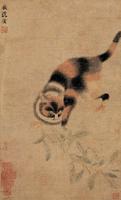
狸猫图
Qian Xuan
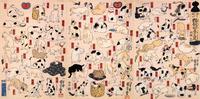
Cats suggested as the fifty three stations of the Tokaido
Utagawa Kuniyoshi
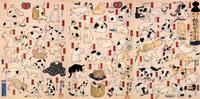
55 cats representing the 53 stations of the Tokaido
Utagawa Kuniyoshi
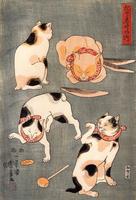
Four cats in different poses
Utagawa Kuniyoshi
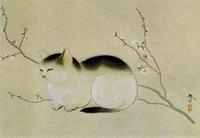
Cat
Hishida Shunso
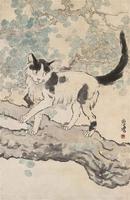
Cat
Xu Beihong
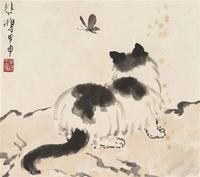
Kitten with Butterfly
Xu Beihong
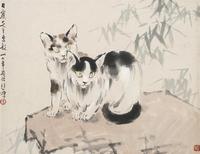
Cats on Rock
Xu Beihong
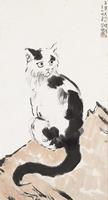
Cat
Xu Beihong
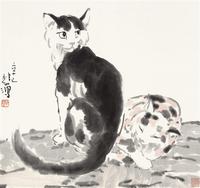
Two Cats
Xu Beihong
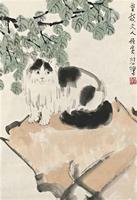
Cat
Xu Beihong
Cat and Butterfly
Bada Shanren
Little Cat
Theophile Steinlen
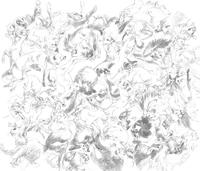
animals compilation
Claire Wendling
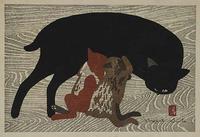
Cat and Kittens
Kiyoshi Saito
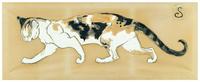
Walking cat
Theophile Steinlen
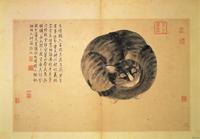
Cat (Sketches from Life)
Shen Zhou
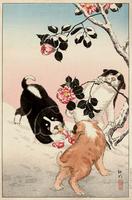
Camellia and Puppies in Snow
Shotei Takahashi
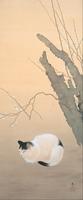
Cat and Plum Blossoms
Hishida Shunso