Analisi esperta di Hawk di Utagawa Kuniyoshi
Stile: Ukiyo-e · Genere: animal painting
Expert Analysis of "Hawk" by Utagawa Kuniyoshi
Context and Style
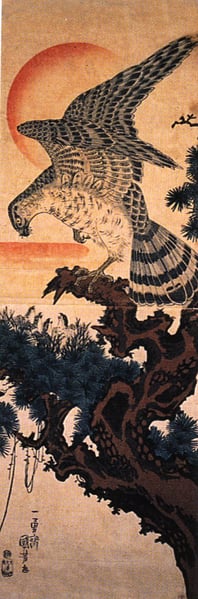
Utagawa Kuniyoshi (1797–1861) was a master of the ukiyo-e tradition, renowned for his dramatic warrior prints, legendary scenes, and dynamic animal studies. Within the ukiyo-e genre, animal paintings were a specialized subset, often imbued with symbolic and narrative weight. Kuniyoshi’s Hawk exemplifies his ability to blend meticulous naturalism with the expressive, stylized conventions of the floating world. The hawk, a recurring motif in his oeuvre, reflects both his technical virtuosity and his deep engagement with Japanese cultural iconography.
Significance within Ukiyo-e and Its Period
-
Symbolic Resonance: In Edo-period Japan, the hawk was a powerful emblem of martial prowess, nobility, and keen vision—virtues associated with the samurai class. Kuniyoshi elevates this bird from mere ornithological study to a cipher for strength and vigilance, aligning with the ukiyo-e tradition of using animals to convey human qualities (e.g., carp for perseverance, tigers for ferocity).
-
Compositional Innovation: Unlike many ukiyo-e animal prints that placed creatures in static, decorative poses, Kuniyoshi’s Hawk often captures a moment of intense alertness or imminent action—wings half-spread, talons tensed, eyes locked on the viewer or a distant prey. This dynamism reflects his absorption of Western perspective and chiaroscuro, which he adapted to the woodblock medium, giving the hawk a volumetric, almost sculptural presence rarely seen in earlier ukiyo-e.
-
Technical Mastery: Kuniyoshi’s handling of the hawk’s plumage demonstrates remarkable subtlety. Through precise bokashi (gradated color printing) and intricate linework, he renders the subtle textures of feathers—soft down at the chest, sharp primaries at the wingtips—while the bold silhouette of the bird against a plain or subtly washed background (often a pale sky or moon) creates a striking graphic impact typical of the best ukiyo-e.
-
Genre Elevation: Animal painting in ukiyo-e was often marginalized as a minor genre, but Kuniyoshi’s Hawk raises it to the level of high art. His commitment to portraying animals with character and psychological depth—here, the hawk’s unblinking stare suggests both predator and symbol—helped expand the thematic range of ukiyo-e, influencing later artists such as Kawanabe Kyōsai.
Conclusion
Kuniyoshi’s Hawk is significant because it fuses the ukiyo-e love for decorative elegance with a raw, almost naturalistic observation of animal life. It embodies the spirit of its age—a period of cultural synthesis in which traditional Japanese symbols met new artistic techniques—and stands as a testament to the artist’s ability to transform a familiar creature into a timeless icon of power and grace. For collectors and scholars, this work exemplifies how ukiyo-e transcended mere popular prints to become a vehicle for profound symbolic expression.
Visivamente simili
20 opere con composizione e palette affini
Hochwido
Owon
Eagles in Withered Tree
Bada Shanren
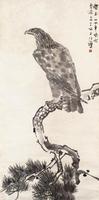
Eagle
Xu Beihong
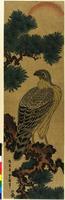
Kachoga. Falcon on a pine branch, rising sun above
Utagawa Toyokuni II
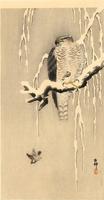
Goshawk on snowy branch
Ohara Koson
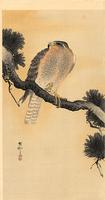
Falcon on a Branch
Ohara Koson
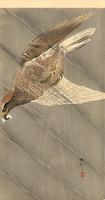
Eagle in descent
Ohara Koson
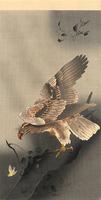
Swooping Eagle
Ohara Koson
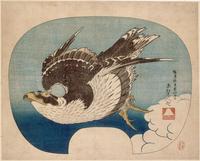
Falcon in flight
Katsushika Hokusai
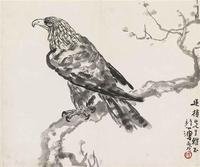
Hawk
Xu Beihong
Pine Tree, White Hawk, and Rock
Lan Ying
Eagle under snow
Ohara Koson
Eagle
Xu Beihong
Flowers and Birds of the Four Seasons
Kanō Motonobu
Jeu Princier. Mongol
Paul Jacoulet
Phoenix and Sun
Ito Jakuchu
Hawk on a ceremonial stand
Katsushika Hokusai
Painting on Zen Enlightenment (Sanping baring his chest and Shigong stretching his bow)
Kanō Motonobu
Two Wild Geese
Bada Shanren
Pine and Deer
Bada Shanren