Analisi esperta di Eagle under snow di Ohara Koson
Stile: Shin-hanga · Genere: wildlife painting
Expert Analysis: "Eagle under snow" by Ohara Koson
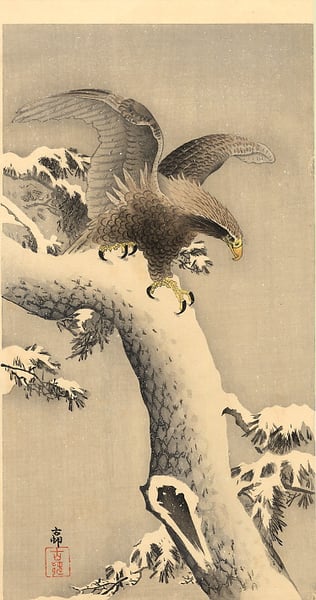
Ohara Koson’s Eagle under snow is a masterful example of the Shin-hanga (“new prints”) movement, which revitalized traditional Japanese woodblock printing in the early 20th century by blending ukiyo‑e aesthetics with Western naturalism and atmospheric rendering. The work belongs to the wildlife painting genre—a specialty in which Koson excelled, earning him recognition as one of the most accomplished kachō-e (bird‑and‑flower) artists of the era.
Significance within the Shin‑hanga style:
Koson here demonstrates the hallmark Shin‑hanga approach of pairing meticulous, lifelike detail with a restrained, poetic composition. The eagle—a symbol of power and solitude in Japanese art—is depicted not as a static emblem but as a living creature braving the elements. The snow, rendered with subtle gradations of white and gray, creates a soft, volumetric atmosphere that goes beyond the flat decorative patterns of earlier ukiyo‑e. This treatment reflects the Shin‑hanga principle of “Western realism with Japanese soul”: the bird’s feathers are precisely modeled, yet the overall scene retains a painterly, almost haiku‑like simplicity.
Genre‑specific significance:
As a wildlife painting, Eagle under snow elevates the kachō‑e tradition by infusing it with dramatic tension. The heavy snowfall and the eagle’s alert posture introduce a narrative quality—a moment of survival in harsh winter—that transcends mere botanical or ornithological illustration. This aligns with Koson’s broader contribution to Shin‑hanga: he modernized the bird‑and‑flower print by focusing on natural behavior and habitat, moving away from the purely decorative conventions of the 19th century.
Cultural and stylistic impact:
The work embodies the cross‑cultural dialogue at the heart of Shin‑hanga. Koson collaborated with the publisher Watanabe Shōzaburō, who actively sought to export prints to Western collectors. The eagle under snow would have appealed to both Japanese audiences (familiar with the bird as a symbols of strength) and Western viewers (who appreciated the naturalistic detail and tonal subtlety). In this sense, the print is not only a wildlife study but also a cultural bridge—preserving traditional Japanese woodblock craft while embracing modern visual sensibilities.
In summary, Eagle under snow stands as a testament to Koson’s technical mastery and his role in defining the Shin‑hanga wildlife aesthetic. It captures a fleeting, dramatic moment in nature with quiet dignity, proving that a single bird in a snowstorm can convey the movement’s core ambition: to harmonize meticulous observation with enduring artistic beauty.
Visivamente simili
20 opere con composizione e palette affini
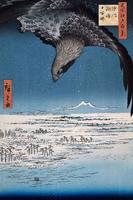
107. Fukagawa Susaki and Jūmantsubo
Hiroshige
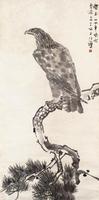
Eagle
Xu Beihong
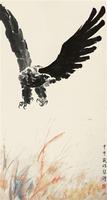
Eagle
Xu Beihong
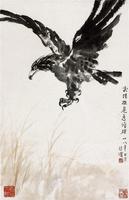
Hawk
Xu Beihong
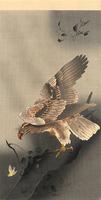
Swooping Eagle
Ohara Koson
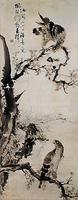
Hochwido
Owon
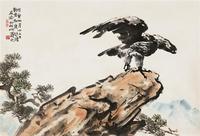
Eagle
Xu Beihong
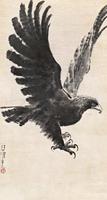
An Eagle
Xu Beihong

Hawk
Utagawa Kuniyoshi
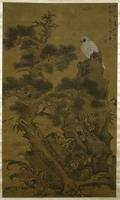
Pine Tree, White Hawk, and Rock
Lan Ying
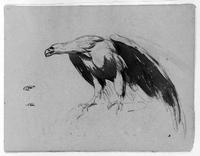
Eagle (from Sketchbook)
Thomas Sully
Otto of the Silver Hand 27
Howard Pyle
Hawk
Xu Beihong
Eagle in descent
Ohara Koson
Grand Pine Tree
Xu Beihong
Self-portrait
Chen Hongshou
Pine and Deer
Bada Shanren
Eagle and Snake
William Hawkins
Pin on the Cliff
Shitao
Phoenix and Sun
Ito Jakuchu