Analyse experte de Shoki and Demon, Edo period de Utagawa Kuniyoshi
Style : Ukiyo-e · Genre : mythological painting
Expert Analysis: "Shoki and Demon" by Utagawa Kuniyoshi (Edo Period)
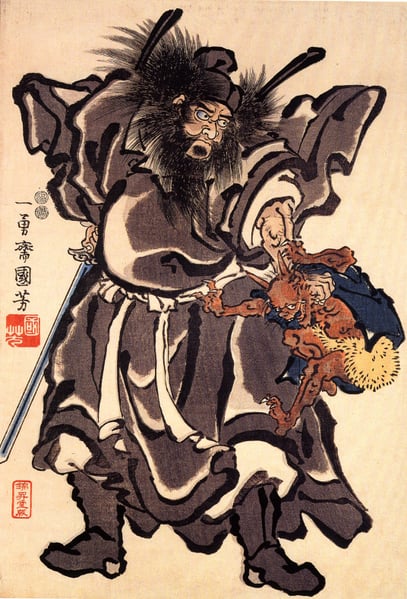
Utagawa Kuniyoshi’s Shoki and Demon is a masterful example of ukiyo-e’s mythological genre, standing out for its dynamic composition and psychological tension. The print depicts the legendary demon-queller Shoki (the Japanese adaptation of the Chinese deity Zhong Kui), who is shown in a moment of fierce confrontation with a smaller, cowering demon. What makes this work significant within its period and style is threefold:
1. Synthesis of Folklore and Formal Innovation
Kuniyoshi revitalized the traditional theme of Shoki by infusing it with the dramatic energy of ukiyo-e’s warrior prints (musha-e). Unlike earlier static depictions, Kuniyoshi’s Shoki lunges forward with swirling robes, his face contorted in righteous fury. The demon, rendered with exaggerated claws and a twisted posture, recoils in a counterbalanced spiral. This interplay of movement—driven by bold, curved lines (kuruma brushwork) and abrupt tonal contrasts—borrows from Kabuki theater’s stage combat, giving the print a palpable sense of impending action.
2. Technical Virtuosity in Woodblock Printing
Kuniyoshi’s command of the ukiyo-e medium is evident in the intricate carving of Shoki’s beard and the demon’s fur, achieved through fine kento registration and layered color blocks. The deep indigo of Shoki’s robe is offset by the demon’s pale, sickly skin, a deliberate chromatic clash that heightens the moral dichotomy. The use of bokashi (gradation) in the background creates a smoky, liminal space—neither heaven nor earth—emphasizing the supernatural setting.
3. Cultural and Artistic Legacy
This print exemplifies Kuniyoshi’s fascination with the monstrous and the grotesque, which would later influence modern Japanese horror aesthetics (yōkai culture) and even early manga. His Shoki is not merely a religious icon but a psychological symbol of vanquishing inner demons—a theme that resonated with the anxieties of the late Edo period. The work’s bold, graphic lines and exaggerated poses also prefigure the visual vocabulary of 20th-century Japanese comics and animation.
In sum, Shoki and Demon is not a simple illustrative piece; it is a virtuosic blend of folklore, theatricality, and technical prowess that pushed ukiyo-e beyond decoration into a visceral narrative art. Kuniyoshi’s ability to make the myth feel immediate—and his demon both terrifying and pitiable—secures this print’s place as a cornerstone of Edo-period mythological painting.
Visuellement similaire
20 œuvres à la composition et à la palette proches
Yamamoto Takeru no Mikoto between burning grass
Utagawa Kuniyoshi
The Hundred and Eight Heroes of the Popular Suikoden
Utagawa Kuniyoshi
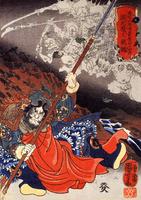
Konseimao hanzui beset by demons
Utagawa Kuniyoshi
Kabuki Actor Onoe Matsusuke I as the Lay Priest Yuasa Magoroku
Tōshūsai Sharaku
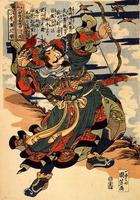
Shoriko kaei shooting a wild goose
Utagawa Kuniyoshi
Chinese Warriors, from series Suikoden
Toyota Hokkei
Ichikawa Ebizō as the itinerant monk Ryōzan
Tōshūsai Sharaku
Heroes of china and Japan
Utagawa Kuniyoshi
Yoshi tomigoro
Tsukioka Yoshitoshi
Songoku, the Monkey King and the Jewelled Hare by the Moon
Tsukioka Yoshitoshi
Father and Son Members of the Forty Seven Rônin from Chûshingura
Utagawa Kunisada
Shikamatsu Kanroku Yukishige
Utagawa Kuniyoshi
Kabuki Actor Ichikawa Komazō II as Minase Rokurō Munezumi in a Kamishimo
Tōshūsai Sharaku
Miura Jirôemon Kanetsune
Utagawa Kuniyoshi
Lin Chong
Tsukioka Yoshitoshi
Seven Gods of Good Fortune
Hakuin Ekaku
Happinata Koju on a rearing horse
Utagawa Kuniyoshi
Oguri Hangan Sukeshige and Yamasaki
Utagawa Sadatora
Hayami Sôzaemon Mitsutaka
Utagawa Kuniyoshi
Kamigashihime stabbing a giant spider
Utagawa Kuniyoshi