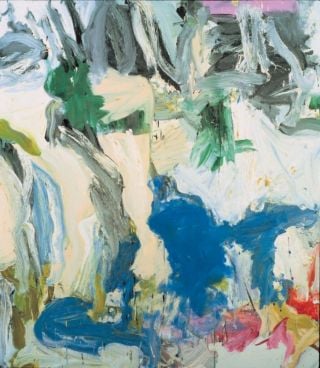
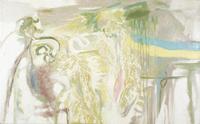
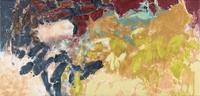
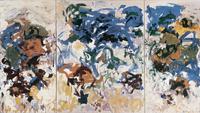
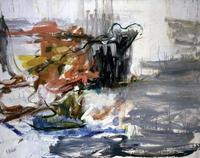
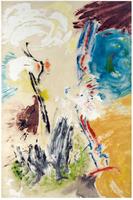
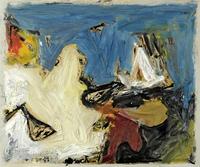
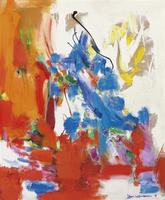
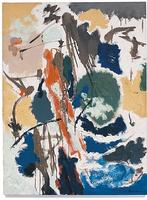
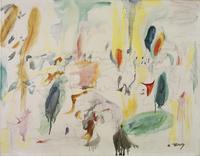
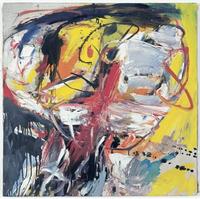
The significance of Willem de Kooning's "Two trees on Mary Street . . . Amen!" lies in its embodiment of Abstract Expressionism’s core principles—spontaneity, gestural energy, and emotional immediacy—while the enigmatic title introduces a personal, almost narrative counterpoint to the work’s abstract genre. De Kooning, a leading figure of this movement, often balanced abstraction with cryptic figural references; here, the title hints at a specific place (“Mary Street”) and a ritualistic closure (“Amen!”), suggesting that the abstract forms are rooted in lived experience or memory. This tension between pure abstraction and autobiographical resonance is characteristic of his practice, making the painting a key example of how Abstract Expressionism could convey deeply subjective meaning through non-representational means. The artwork’s significance is reinforced by its status as a work from de Kooning’s mature period, where his vigorous brushwork and layered compositions became synonymous with the movement’s radical break from traditional representation.