Expert analysis of Milton Resnick’s Painting I
Style: Abstract Expressionism · Genre: abstract
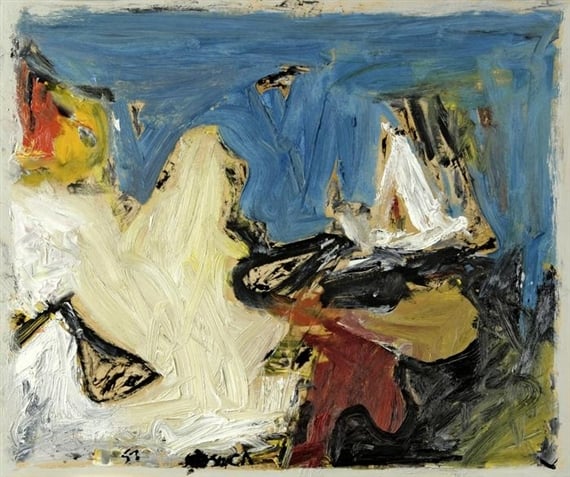
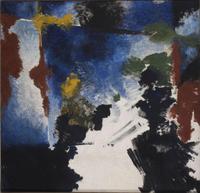
Milton Resnick's Painting I stands as a vital contribution to Abstract Expressionism, particularly within the movement's second-generation New York School. Executed in the late 1940s or early 1950s, the work exemplifies Resnick's intensive, laborious process—characterized by a dense, heavily impastoed surface that seems both physical and atmospheric. Unlike the more gestural, linear dynamism of de Kooning or the color-saturated fields of Rothko, Resnick layered thick paint into a monolithic, almost geological texture, creating a shallow, breathing space that hovers between the organic and the cosmic. The near-monochromatic palette (often dominated by deep grays, muted whites, or earthy browns) emphasizes the physicality of the medium itself, pushing abstraction toward a meditative, existential weight. Painting I is significant because it demonstrates how Abstract Expressionism could evolve beyond the heroic gesture into a quieter, more reflective materiality—anticipating later painterly abstraction and establishing Resnick as a crucial, if sometimes overlooked, figure in the movement’s push toward the all-over, embodied canvas.
Visually similar
20 works with related composition and palette
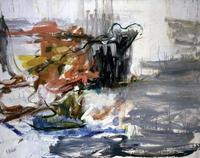
Oisin's Dream
Mary Abbott
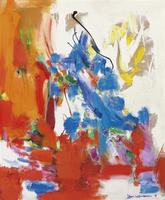
Wild Vine
Hans Hofmann
Il pendolo
Afro
Janus-Kopf
Bernard Schultze
Untitled
Helmut Sturm
Untitled I
Willem de Kooning
Composition with Black
Alexander Bogen
Figure
Afro
Copla
Esteban Vicente
Sommitelma
Tove Jansson
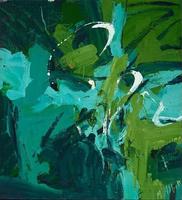
All Green
Mary Abbott
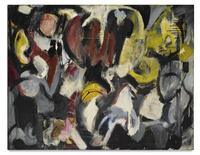
Months and Moons
Grace Hartigan

Vie multipliée
Chu Teh-Chun
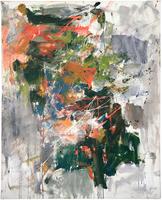
Untitled
Joan Mitchell
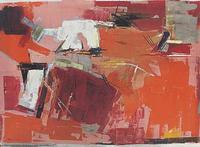
Untitled
Francis Bott
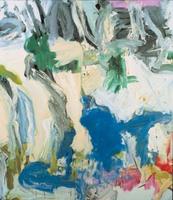
Two trees on Mary Street . . . Amen!
Willem de Kooning
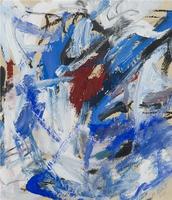
Abstrakter Expressionismus
Mary Abbott
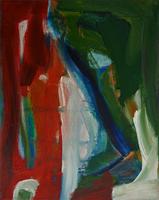
Forest Edge 2. - abstract painting - nr. 5.029 - by Fons Heijnsbroek - Dutch artist
Fons Heijnsbroek
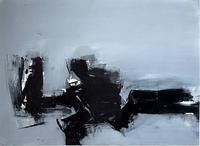
Untitled
Luis Feito
Abstraction (Rupture)
Alexander Rodchenko