Expert analysis of Max Ernst’s Europe after the Rain II
Style: Surrealism · Genre: symbolic painting
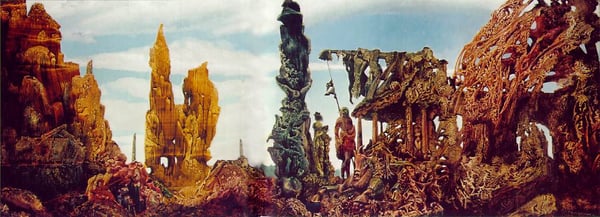
Max Ernst’s Europe after the Rain II (1940–1942) is a landmark of Surrealist symbolic painting from his American period, a time when the artist was deeply influenced by the trauma of World War II and his recent exile from Europe. Painted using the decalcomania technique—where paint is pressed between surfaces to create organic, unpredictable textures—the work embodies Surrealism’s commitment to automatism and the subconscious.
Symbolic Content & Significance
The painting depicts a post-apocalyptic landscape: a decaying, skeletal continent (Europe) reduced to a rotting, skin-like terrain. Ernst layers biomorphic forms, architectural ruins, and a ghastly central figure that is part human, part landscape, suggesting the fusion of body and earth in death. This symbolic imagery directly responds to the destruction of Europe under fascism, making the work one of the most potent political statements in Surrealist art. Unlike earlier Surrealist fantasies, here the dream is a nightmare—a direct allegory of war’s aftermath.
American Period Context
In his American period, Ernst merged European Surrealist iconography with the vast, uninhabited vistas of the New World. Europe after the Rain II reflects this transition: while the subject mourns the Old World, the technique (decalcomania) and scale (large, mural-like) also anticipate Abstract Expressionism’s emphasis on process and texture. The work thus bridges Surrealism’s symbolic roots with later American abstraction, cementing Ernst’s role as a pivotal figure in mid-century art.
Significance
- Historical commentary: One of the first major Surrealist paintings to directly address contemporary political catastrophe.
- Technical innovation: Showcases decalcomania as a tool for generating trauma-laden, organic forms.
- Critical turning point: Marks Ernst’s shift from European Surrealism to an American-inflected, monumentally ominous style.
The painting remains a haunting emblem of Surrealism’s ability to transform personal exile and global horror into enduring, symbolic myth.
Museum / Gallery
Visually similar
20 works with related composition and palette
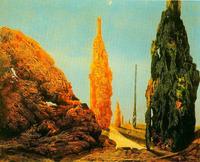
Lone Tree and United Trees
Max Ernst
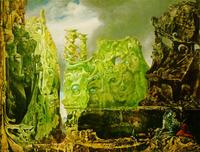
The Eye of Silence
Max Ernst
Forest
Max Ernst
Les etrangers
Wolfgang Paalen
The Gray Forest
Max Ernst
Triptych
Jacek Yerka
The large forest
Max Ernst
Fata Alaska
Wolfgang Paalen
Painting for Young People
Max Ernst
Triptych - the middle part
Jacek Yerka
Not From Earth
Radi Nedelchev
The Menin Road
Paul Nash
Untitled
Albin Brunovsky
"Le dieu bleu" - set design
Leon Bakst
Day and Night
Max Ernst
WENN AUCH VON ANDERER SCHÖNHEIT
Richard Oelze
Warning
Ivan Marchuk
The Anti-Pope
Max Ernst
The Woman at the Cathedral
Hans Bellmer
Cathedral
Jacek Yerka