
Expert analysis of Max Ernst’s The Eye of Silence
Style: Surrealism · Genre: allegorical painting
Expert Analysis of "The Eye of Silence" by Max Ernst
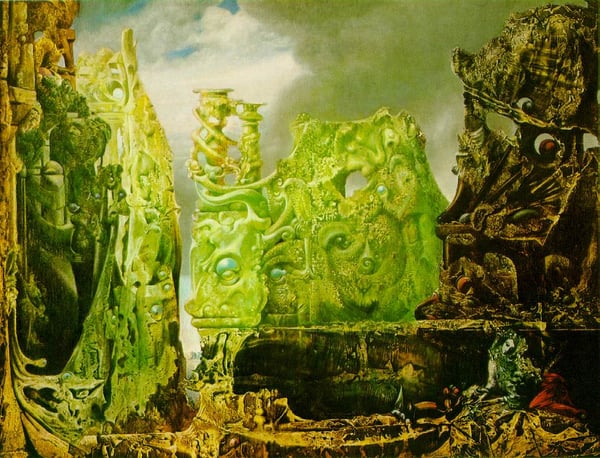
Max Ernst’s The Eye of Silence (1943–44) stands as a masterwork of his American period, when the exiled Surrealist fused European avant-garde techniques with the vast, uncanny landscapes of his new homeland. Executed in the artist’s signature grattage (scraping) and decalcomania (pressed paint) methods, the painting epitomizes Surrealism’s quest to unlock the subconscious through automatism and unexpected textures.
Significance within Surrealism:
As an allegorical painting, The Eye of Silence embodies the Surrealist obsession with dreamlike, ambiguous spaces where organic and mineral forms merge. The central “eye”—a dark, liquid pupil set within a craggy, biomorphic rock—functions as a hypnotic focal point, simultaneously watching and absorbing the environment. This motif echoes Ernst’s earlier “forest” and “bird” themes but here becomes a sentinel of silence, suggesting a primal, pre-linguistic consciousness. The work’s title implies that true knowledge arises not from speech or reason but from silent, visionary perception—a core Surrealist tenet.
Significance within Ernst’s American Period:
Painted after Ernst fled Nazi-occupied Europe and settled in the American Southwest, The Eye of Silence reflects his exposure to the desert’s stark geology and Native American earthworks. The layered, eroded forms recall canyons and petrified wood, while the muted greens, ochres, and blacks evoke a primeval, untamed wilderness. This period marked a shift from the eerie European forests of his earlier work toward a more monumental, almost cosmic sublimity, infusing Surrealism with a distinctly American sense of scale and mystery.
Technical Innovation:
Ernst’s grattage technique—scraping wet paint across a textured canvas—produces the jagged, fossil-like surfaces that seem to have been carved by wind and time. This process aligns with the Surrealist goal of eliminating conscious control, allowing chance and the material itself to dictate form. The result is a painting that feels both ancient and alien, a frozen moment from a half-remembered dream.
The Eye of Silence remains a seminal example of how Surrealism evolved during its transatlantic migration, blending European irrationality with American grandeur to create a haunting, silent witness to the subconscious.
Museum / Gallery
Visually similar
20 works with related composition and palette
Imperial Monument of Woma-Child. Gala (Utopian Fantasy)
Salvador Dali
WENN AUCH VON ANDERER SCHÖNHEIT
Richard Oelze
JOB AND THE JUDGEMENT OF PARIS
Ernst Fuchs
Europe after the Rain II
Max Ernst
Lone Tree and United Trees
Max Ernst
"Le dieu bleu" - set design
Leon Bakst
Warning
Ivan Marchuk
Invention of a Dream
Richard Oelze
Caprice decoration, a group of ruins inhabited by snakes, surmounted by an ancient tomb, a delicate etching pine in the fund at the bottom right palette
Giovanni Battista Piranesi
Untitled
Zdzislaw Beksinski
Anti-Protonic Assumption
Salvador Dali
Untitled
Zdzislaw Beksinski
CHERUB WITH THE HEMATITE EYE
Ernst Fuchs
Untitled
Zdzislaw Beksinski
The Evening of the Deluge
John Martin
Untitled
Zdzislaw Beksinski
Last Judgement
William Blake
Archimboldo
Enrico Donati
Triptych
Jacek Yerka
Cathedral
Jacek Yerka