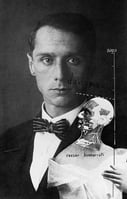
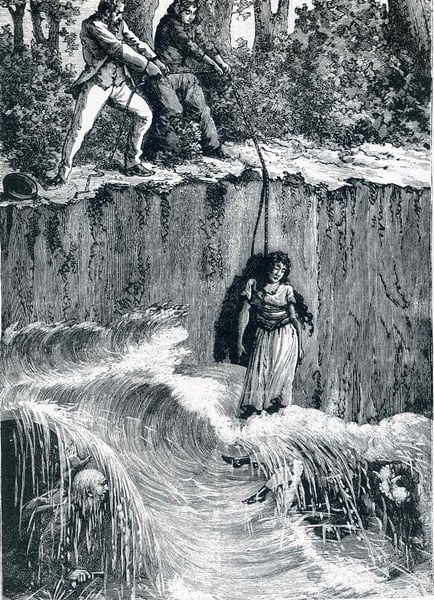
Max Ernst の Illustration to "A Week of Kindness" の専門的な分析
スタイル:Surrealism · ジャンル:illustration
Expert Analysis: "Illustration to 'A Week of Kindness'" by Max Ernst
Max Ernst’s Illustration to “A Week of Kindness” is a pivotal example of Surrealist collage—a technique Ernst pioneered and elevated to a high art form during his First French period (1922–1941). This work belongs to his 1934 collage novel Une Semaine de Bonté (A Week of Kindness), a landmark of Surrealist book arts that demonstrates the movement’s core principles: the liberation of the unconscious, the disruption of rational narrative, and the creation of startling, dreamlike realities.
Significance within Surrealism and the Period
-
Collage as Automatism: Ernst’s method for this series involved cutting and reassembling elements from 19th-century Victorian engravings and popular illustrated journals. By removing these images from their original contexts and recombining them through chance and intuitive selection, he enacted a form of visual automatism—a Surrealist technique intended to bypass conscious control and access the subconscious. This work embodies the Surrealist dictum that the most powerful art arises from unexpected, irrational encounters.
-
Subversion of Narrative: The Week of Kindness novel consists of seven sections (one for each day of the week) exploring themes of eroticism, violence, and metamorphosis. Ernst deliberately undermined conventional storytelling: the illustrations are not sequential in a linear plot but instead form a disjointed, oneiric sequence that mimics the logic of dreams. The specific illustration in question—like all in the series—presents a hybrid creature or impossible scenario (e.g., human-animal hybrids, architectural absurdities) that defies rational explanation, forcing viewers to create their own psychological interpretations.
-
Historical Context: Created in 1934, this work emerges from a turbulent moment in European history, with the rise of fascism and the approach of World War II. Ernst’s use of Victorian imagery—an era associated with bourgeois stability, colonialism, and repressed sexuality—is deliberately destabilizing. The violent, erotic, and grotesque juxtapositions in these collages can be read as an attack on the hypocrisies of bourgeois culture and a premonition of the coming cataclysm.
-
Genre and Medium: As an illustration for a livre d’artiste (artist’s book), this work challenges the traditional hierarchy of fine art. Ernst elevated illustration to the same imaginative plane as painting, using the book format to disseminate Surrealist ideas to a wider audience. The collage technique itself—using cheap, mass-produced printed matter—was a radical act of détournement, reclaiming and repurposing commercial imagery for avant-garde critique.
What Makes This Work Significant
-
Pinnacle of Surrealist Collage: A Week of Kindness is arguably the most accomplished example of Ernst’s collage novels, surpassing even his earlier La Femme 100 Têtes. It is a masterclass in visual poetry, where each fragment acquires new symbolic weight in its displaced context.
-
Influence on Later Art: This work directly influenced the use of collage in Pop Art (e.g., Richard Hamilton, Robert Rauschenberg) and contemporary photomontage. It also prefigured postmodern strategies of appropriation and pastiche.
-
Psychological Depth: The specific illustration evokes Franz Kafka’s sense of uncanny transformation—birds with human heads, men with lion claws, giant hands reaching from the sky. It forces the viewer to confront the repressed fears and desires lurking beneath the veneer of rational civilization.
In summary, Illustration to “A Week of Kindness” is not merely an illustration; it is a radical manifesto of Surrealist technique, a subversive historical document, and a haunting, timeless image that continues to challenge our perception of reality.
Museum / Gallery
視覚的に類似
構図やパレットが近い作品 20 件
Illustration to "A Week of Kindness"
Max Ernst
Here neither
Francisco Goya
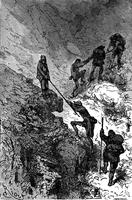
Journey to the Center of the Earth
Edouard Riou
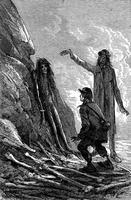
Journey to the Center of the Earth
Edouard Riou
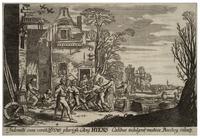
Winter. State 3.
Esaias van de Velde
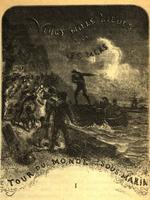
Vingt mille lieues sous les mers
Edouard Riou
Summer
Esaias van de Velde
Journey to the Center of the Earth
Edouard Riou
Jacob Finds Rest in a Rugged Landscape and Dreams of a Ladder
Salvator Rosa
Donkeyskin
Gustave Dore
Autumn
Esaias van de Velde
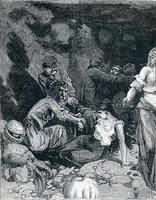
Illustration to "A Week of Kindness"
Max Ernst
Roman Augurs Interpreting the Flight of Birds
Salvator Rosa
Death of Mark the Evangelist, Alexandria, AD 64
Jan Luyken
The Suicides II
Gustave Dore
The Vicious Husband
Titian
Burning of Barnabas at Salamanca, Cyprus, AD 64
Jan Luyken
The Tree
Gustave Dore
Mob
Francisco Goya
Journey to the Center of the Earth
Edouard Riou