
Expertenanalyse zu Gustave Dores The Suicides II
Stil: Romanticism · Genre: illustration
Expert Analysis: "The Suicides II" by Gustave Doré
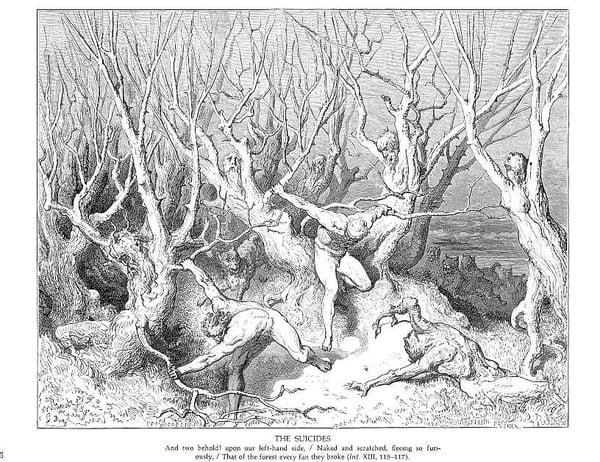
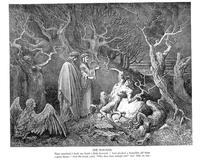
Gustave Doré’s The Suicides II stands as a masterful example of Romantic illustration, a genre where the artist’s technical virtuosity meets the era’s fascination with intense emotion, the macabre, and the sublime. Created as part of his celebrated series for Dante Alighieri’s Inferno, this work visually interprets Canto XIII, where the souls of suicides are transformed into gnarled, bleeding trees, tormented by Harpies.
Significance within Romanticism
Romanticism prized individual suffering, the dark power of nature, and the confrontation with death—themes Doré renders with visceral force. The composition plunges the viewer into a haunting, shadowy forest, where twisted tree forms mirror human anguish. Doré’s use of stark chiaroscuro—deep blacks against pale, ghostly light—heightens the dramatic tension, a hallmark of Romantic printmaking. The figures of the Harpies, part woman, part bird, embody the sublime terror that Romantic artists sought to evoke: beauty and horror intertwined. This scene is not merely an illustration but a psychological landscape, reflecting the Romantic belief that external nature can externalize inner torment.
Significance within Illustration
Doré elevated illustration from a secondary art to a powerful narrative medium. The Suicides II demonstrates his unparalleled ability to translate Dante’s poetic imagery into a visually compelling, atmospheric scene. Every detail—the contorted branches, the skeletal hands emerging from trunks, the violent flurry of wings—serves the story, yet also stands alone as a work of deep emotional impact. Doré’s illustrations for The Inferno were revolutionary; they defined how generations imagined Dante’s vision, blending literary fidelity with Romantic invention. In this plate, his chiaroscuro and intricate line work create a sense of movement and decay that pushes beyond mere documentation, transforming the page into a stage for damnation.
Conclusion
The Suicides II is significant because it encapsulates the Romantic movement’s core preoccupations—suffering, nature, and the supernatural—through the accessible yet powerful medium of illustration. Doré’s mastery of light and shadow, his emotional intensity, and his faithfulness to Dante’s text make this work a landmark in art history, proving that illustration can achieve the sublime heights of any fine art genre.
Visuell ähnlich
20 Werke mit ähnlicher Komposition und Farbpalette
The Inferno, Canto 13
Gustave Dore
The Vicious Husband
Titian
Transformation into Snakes
Gustave Dore
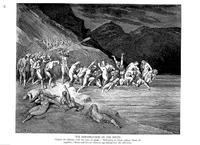
The Embarkation of the Souls
Gustave Dore
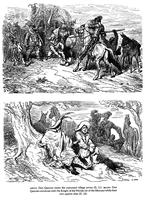
Don Quixote
Gustave Dore
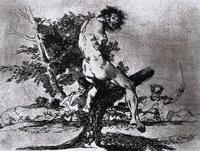
This is worse
Francisco Goya
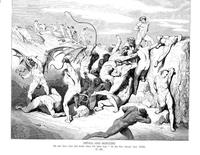
Devils and Seducers
Gustave Dore
Schismatics--Mahomet
Gustave Dore
Devils and Barrators
Gustave Dore
Don Quixote
Gustave Dore
Don Quixote
Gustave Dore
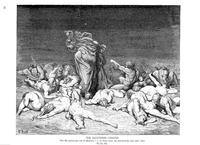
The Gluttons--Ciacco
Gustave Dore
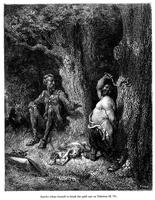
Don Quixote
Gustave Dore
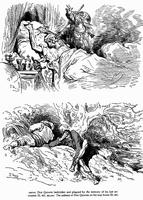
Don Quixote
Gustave Dore
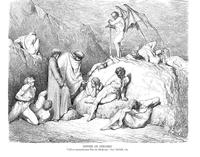
Sower of Discord
Gustave Dore
Five Male Nudes
Albrecht Durer
Thieves
Gustave Dore
The bathers
Rembrandt
Burning of Dulcin and His Wife, Novarra, AD 1308
Jan Luyken
The Suicides
Gustave Dore