
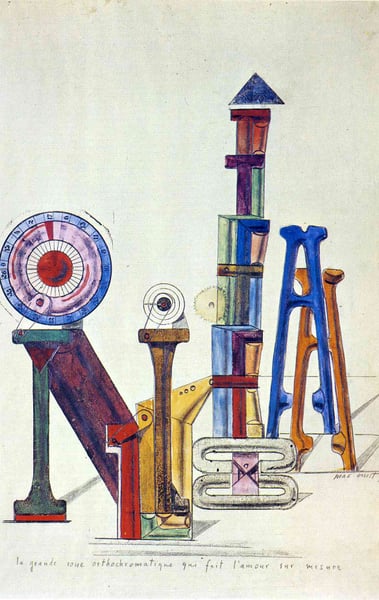
Analisi esperta di La Grande Roue Orthochromatique… di Max Ernst
Stile: Dada · Genere: symbolic painting
Expert Art Historical Analysis: La Grande Roue Orthochromatique… (The Great Orthochromatic Wheel) by Max Ernst
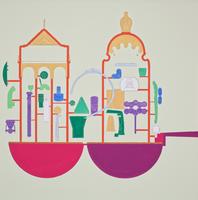
Max Ernst’s La Grande Roue Orthochromatique… stands as a quintessential early Dada work, merging the movement’s anti-rational ethos with the artist’s emerging fascination with symbolic, psychologically charged imagery. Painted during Ernst’s formative years (c. 1919–1920), this piece reflects Dada’s deliberate assault on traditional artistic values—namely, logic, coherence, and craftsmanship—while simultaneously prefiguring the proto-Surrealist themes that would dominate his later career.
Stylistic and Period Significance
As a Dada work, the painting rejects conventional beauty and narrative in favor of absurd, often mechanomorphic forms. The title itself is a Dadaist provocation: La Grande Roue Orthochromatique translates to “The Great Orthochromatic Wheel,” a phrase seemingly borrowed from photographic science (orthochromatic plates were sensitive to blue-green light). Yet the artwork is not a literal illustration of a wheel; instead, it presents a hallucinatory assemblage of fragmented shapes, arcs, and biomorphic elements that suggest a machine-like structure spinning into chaos. This subversion of scientific terminology embodies Dada’s mockery of rational progress—a core principle of the movement, especially in the wake of World War I’s devastation.
The “symbolic painting” genre, as noted in the facts, is key to understanding the work’s depth. Ernst layers the composition with enigmatic signs—perhaps cogs, gears, or abstracted genitalia—that resist fixed meaning. The wheel motif, while evoking industrial modernity, also recalls medieval or alchemical symbols of repetition and cyclic fate, a duality that Ernst would explore further in his Surrealist “collage novels.” The orthochromatic reference may even hint at a distorted perception of reality, as if the scene is viewed through a flawed lens, mirroring Dada’s embrace of chance and dislocation.
Significance in Ernst’s Early Career
This painting marks a critical transition between Ernst’s expressionist beginnings and his later adoption of frottage, collage, and automatic drawing. The fragmented, wheel-like form anticipates the “rotoreliefs” and kinetic obsessions found in Dada sculptures by Marcel Duchamp, while the title’s pseudo-scientific jargon aligns with Ernst’s contemporary collages that juxtaposed anatomical diagrams with insect-like machines (e.g., The Hat Makes the Man). La Grande Roue Orthochromatique… is also an early example of Ernst’s “symbolic” approach—refusing to depict a comprehensible object, it instead prompts the viewer to generate their own associations, a key Dada strategy to undermine authorial control.
Legacy
In the broader Dada context, this work is significant for its synthesis of mechanical anonymity and poetic strangeness. It contributes to the movement’s critique of perception and representation, while also serving as a bridge to Surrealism’s exploration of the unconscious. Today, it remains a compelling testament to Ernst’s ability to transform ordinary industrial imagery into a site of radical, liberating ambiguity—an achievement that defines the very spirit of Dada.
Visivamente simili
20 opere con composizione e palette affini
Hydrometric Demonstration
Max Ernst
The slug room
Max Ernst
Le Démon Du Saturne
Anton Prinner
Série Coleccionador
Antonio Areal
Painting (formerly Machine)
Morton Schamberg
Balance
Francis Picabia
Untitled
Max Ernst
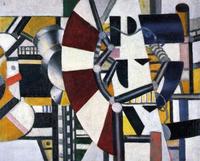
Machine elements
Fernand Leger
Antro II
Hedda Sterne
The Station
Fernand Leger
CQFD
Jaroslav Serpan
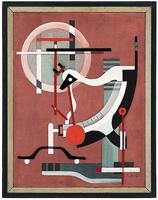
The letter scale
Gosta Adrian-Nilsson
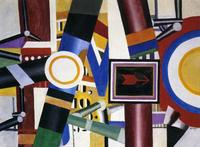
The level crossing (final state)
Fernand Leger
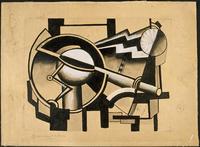
Composition Mechanical Movement cart
Fernand Leger
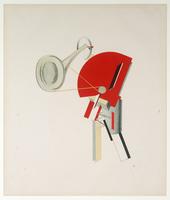
Announcer
El Lissitzky
Frontal Setting
Leonid Sejka
Exlibris of V.Onusaitis
Oleksandr Aksinin
Advertizing Construction for the USSR in Front of the Railroad Station in Leipzig
John Heartfield
Frontalna Postavka
Leonid Šejka
Verpflanzungen Exp7
Alfio Giuffrida