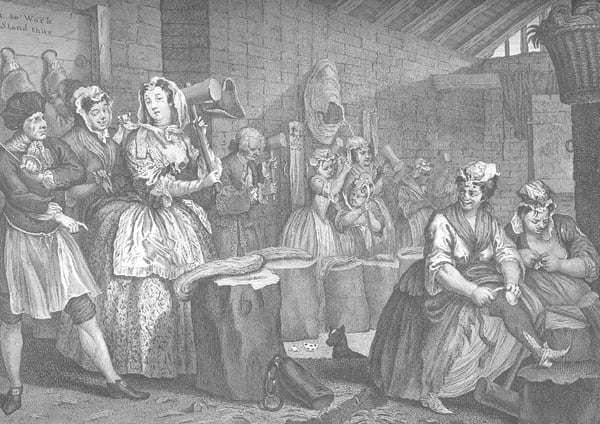
Expert analysis of William Hogarth’s A Harlot's Progress, plate 4
Style: Rococo · Genre: genre painting
Expert Analysis of A Harlot's Progress, plate 4 by William Hogarth (Rococo, genre painting)
Though executed within the Rococo style—evident in the asymmetrical composition, delicate rocaille ornamentation, and refined handling of surface details—Hogarth’s plate 4 subverts the period’s characteristic levity. The work’s significance lies in its use of Rococo’s ornamental language to expose moral decay rather than celebrate aristocratic pleasure.
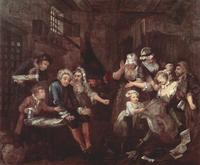
As a genre painting (a depiction of everyday life), Hogarth elevates the serial narrative form to a vehicle for social critique. The scene shows the harlot, now diseased and impoverished, beating hemp in Bridewell prison—a far cry from Rococo’s typical pastoral gallantries. Hogarth contrasts the graceful, sinuous lines of the Rococo with blunt, didactic details (the broken chair, the leer of the overseer) to heighten the moral lesson. The crowded, asymmetrical frame mirrors the disorder of the protagonist’s fall, while the muted palette (unlike Rococo’s usual pastel buoyancy) underscores the grim reality.
In this piece, Hogarth repurposes Rococo’s decorative exuberance to deliver a scathing indictment of 18th-century London’s vice and inequity. This tension between style and subject—lightness of form versus darkness of content—marks A Harlot’s Progress as a pioneering work of moral satire, anticipating the social realism of later centuries.
Visually similar
20 works with related composition and palette
A Harlot's Progress, plate 5
William Hogarth
A Harlot's Progress, plate 6
William Hogarth
Strolling Actresses Dressing in Barn
William Hogarth
A Harlot's Progress, plate 3
William Hogarth
A Harlot's Progress, plate 1
William Hogarth
A futile attempt
Adolf Eberle
Die Gartenlaube (the Garden Arbor)
Toby Edward Rosenthal
The Enraged Musician
William Hogarth
Dance at the Inn
Adriaen van Ostade
Interior Dunha Taberna
Henri Regnault
Married to an Old Maid
William Hogarth
Spoiled children
Enrico Nardi
The prison
William Hogarth
The Peasant Settling His Debt
Adriaen van Ostade
Interior of an Inn
Adriaen van Ostade
The pancake woman
Rembrandt
Gin Lane
William Hogarth
The Penny Wedding
David Wilkie
Cruelty in perfection
William Hogarth
Burglary at Easter Eve
Vasily Perov