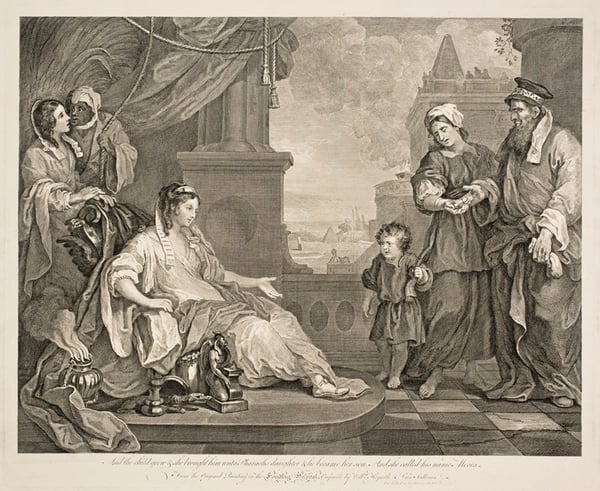
Moses Brought to the Pharaoh's Daughter
Dettagli
Analisi esperta di Moses Brought to the Pharaoh's Daughter di William Hogarth
Stile: Rococo · Genere: religious painting
Expert Analysis: "Moses Brought to the Pharaoh's Daughter" by William Hogarth
Although William Hogarth is best known for his biting social satires and moral series (e.g., A Harlot's Progress), this painting—Moses Brought to the Pharaoh’s Daughter—reveals a lesser-known facet of his career: his engagement with religious subject matter. Executed in the Rococo style, the work demonstrates how Hogarth adapted the lightness, asymmetry, and decorative elegance of Continental Rococo to a biblical narrative, infusing it with the dramatic realism and psychological depth that define his unique voice.
Significance within Rococo and Religious Painting
-
A Rococo Take on a Biblical Theme
Typical Rococo religious paintings (by artists like Boucher or Tiepolo) often prioritize pastel palettes, soft brushwork, and celestial sweetness. Hogarth, however, anchors Moses Brought to the Pharaoh’s Daughter in a more earthy, theatrical composition. The figures are arranged in a serpentine, S-curve—a hallmark of Rococo asymmetry—yet their gestures convey genuine human emotion: the princess’s tender curiosity, the baby Moses’s vulnerable reach, and the attendants’ varied expressions of concern or awe. This blend of ornate elegance and narrative immediacy sets Hogarth apart from his more purely decorative French contemporaries. -
Hogarth’s “Modern Moral” Sensibility in a Sacred Scene
Hogarth brought his sharp eye for character and social interaction to this biblical episode. Rather than idealizing the figures, he gives them individualized faces, costumes, and poses that resemble contemporary English life. The fine fabrics and courtly demeanor of the Pharaoh’s daughter evoke the fashion of Hogarth’s own 18th-century London, making the ancient story feel immediate and relatable. This approach—treating a sacred story with the same verisimilitude he used for street scenes—was innovative and reflected the English Enlightenment’s interest in human psychology over pure divinity. -
Genre-Bridging Achievement
Painted during a period when Hogarth was striving for recognition as a history painter (the highest genre in academic hierarchy), Moses Brought to the Pharaoh’s Daughter illustrates his attempt to elevate religious painting beyond mere doctrinal illustration. The canvas is balanced between Rococo charm and Hogarth’s signature “dramatic moment”—the instant of discovery and compassion. It prefigures his later narrative series by using a single, loaded scene to tell a story, a technique he would perfect in works like The Rake’s Progress. -
Art-Historical Positioning
Hogarth’s religious works are rare, and this painting serves as a fascinating counterpoint to his satirical canon. It proves that his Rococo-influenced sensibilities could serve devotional art without becoming saccharine. The work underscores Hogarth’s versatility and his role as a bridge between the decorative frivolity of French Rococo and the robust, moralizing realism that would define British painting in the generations to come.
Conclusion:
Moses Brought to the Pharaoh’s Daughter is significant because it marries the Rococo’s formal elegance with Hogarth’s distinctly English narrative drive. By applying his acute observational skills to a biblical subject, Hogarth created a religious painting that feels both historically grounded and emotionally accessible—a testament to his belief that even sacred stories must resonate with lived human experience.
Visivamente simili
20 opere con composizione e palette affini
Moses Brought Before Pharaoh's Daughter
William Hogarth
VERTUMNUS AND POMONA
Jacques Chereau
The Marriage of Meleager and Atalantada Carav
Giovanni Battista Piranesi
The Grief of Andromache
Jacques-Louis David
Allegory of Providence
Giovanni Battista Piranesi
ancho no se deja lavar en casa de los duques, aguafuerte y buril
Pierre Alexander Aveline
Apollo and the Cumean Sibyl
Salvator Rosa
Alexander the Great as a Judge
Willem van Swanenburg
ALLEGORIE DER ARCHITEKTUR
Theodor van Thulen
Reineke Fuchs1
Wilhelm von Kaulbach
El Genio De La Libertad
Rosario Weiss Zorrilla
Samson and Delilah
Gustave Dore
CORNELIA IMPERATRICE
Nicolas Bonnart I
AGRIPPINE IMPERATRICE
Nicolas Bonnart I
Susanna before Daniel
Willem van Swanenburg
Birth on Good Friday
Raphael
Cult of Ceres
Jan Saenredam
The Adoration of the Shepherds
Cornelis Cort
Ganymede carried off by the eagle
Giovanni Battista Piranesi
Request of Brabant to Join the Staten
Theodoor van Thulden