Analyse experte de The Distrest Poet de William Hogarth
Style : Rococo · Genre : genre painting
Expert Analysis: "The Distrest Poet" by William Hogarth
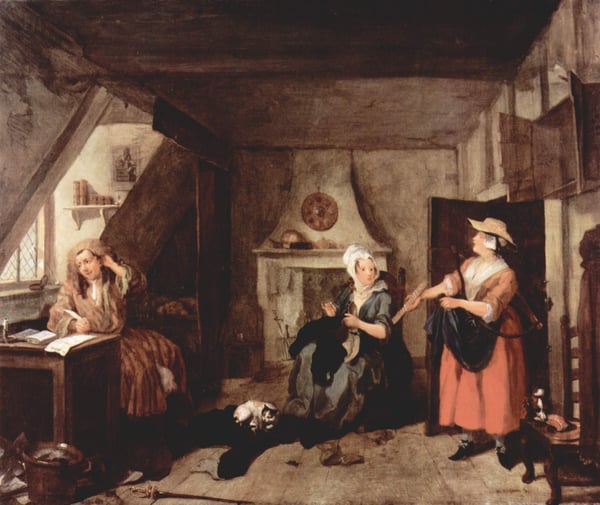
Painted in 1736, William Hogarth’s The Distrest Poet stands as a masterful example of early Rococo genre painting, yet it transcends mere decorative charm through its sharp social satire and narrative complexity. While Rococo often favored playful, aristocratic subjects, Hogarth here turns the lens on the struggling middle class, blending theatrical composition with biting commentary.
Style and Composition:
The scene is crowded with telling details: the poet sits at a cluttered desk, clutching his head in despair, while a milkmaid demands payment and his wife mends a tattered coat. Hogarth employs the Rococo love of asymmetry and fluid lines, but the palette is subdued—browns, grays, and muted reds—contrasting with the typically pastel luxury of Rococo. The chaotic room, with scattered papers and a broken window stuffed with rags, serves as a visual metaphor for the poet’s mental state.
Significance within Rococo and Genre Painting:
Hogarth elevates genre painting by embedding a moral lesson beneath the humorous surface. Unlike contemporary Rococo works that celebrated leisure, The Distrest Poet exposes the harsh reality of artistic patronage and commercialism. The poet’s idealized muse (a painting of Alexander Pope on the wall) clashes with the domestic grind, highlighting the gap between ambition and survival. This tension—between Rococo’s flirtatious elegance and Hogarth’s unflinching realism—makes the work a bridge to the later Enlightenment and Neoclassical concerns about social order.
Legacy:
The print series of this painting (along with its companion, The Enraged Musician) became wildly popular, cementing Hogarth’s reputation as a moral storyteller. Its significance lies in how it uses Rococo’s own visual language—intricate detail, layered symbolism, and dynamic composition—to critique the very society that embraced that style.
Museum / Gallery
Visuellement similaire
20 œuvres à la composition et à la palette proches
An old to Young Girl
Jan Steen
The visit to the nanny
Domenico Induno
Famille dans un intérieur rustique
Thomas Wijck
Breton family In an interior
Alexandre Antigna
Interior of a peasant dwelling
David Teniers the Younger
Der Brief aus dem Feld
Gerolamo Induno
a Couple in An Interior
Jan Miense Molenaer
A country kitchen
William Collins
Man Offering a Glass of Wine to a Woman
Pieter de Hooch
Peasants in an Interior
Adriaen van Ostade
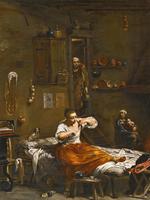
The Flea Hunt
Giuseppe Maria Crespi
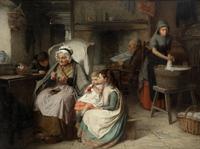
The sewing lesson
Haynes King
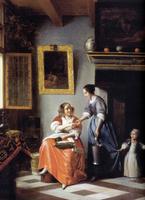
Woman hands over money to her servant
Pieter de Hooch
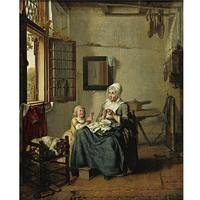
Interior with a woman and child sewing by an open window, a dog asleep in a chair
Wybrand Hendriks
Couple in an interior
Edward Portielje
The Winning Hand
Edward Portielje
The Card Players in an Interior
Jan Steen
The playful kitten
Pierre Jean Edmond Castan
Sunday Morning
Eastman Johnson
Marriage Contract
Jan Steen