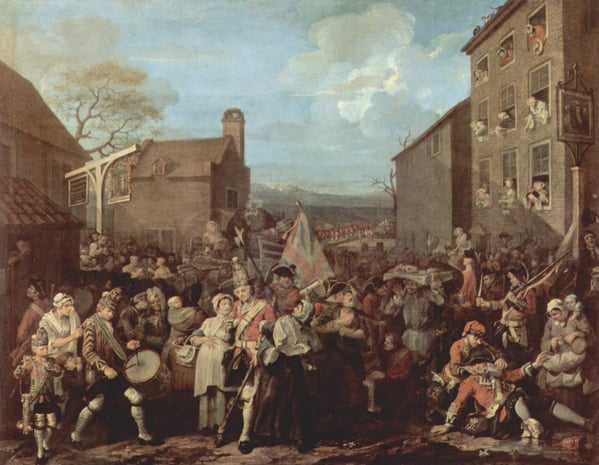
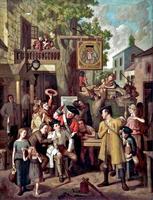
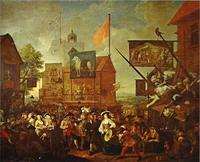
William Hogarth’s The March of the Guards to Finchley is a masterful example of Rococo genre painting, yet it subverts the style’s typical frivolity by infusing it with sharp social and political commentary. Within the Rococo tradition—often associated with decorative elegance, pastel colors, and playful subjects—Hogarth employs a richly detailed, lively composition that captures a chaotic street scene. The work’s significance lies in its use of Rococo’s fluid lines and animated gestures to depict a morally charged moment: the departure of British troops for Finchley during the 1745 Jacobite uprising. Instead of a lighthearted aristocrat, Hogarth presents a vulgar, disordered crowd of soldiers, merchants, and onlookers, exposing the absurdities of military discipline and national duty. This blending of Rococo’s delicate aesthetic with biting satire and narrative complexity elevates the genre painting from mere daily life to a potent critique of contemporary British society. The painting thus stands as a pivotal work where Rococo’s visual elegance becomes a vehicle for moral instruction, a hallmark of Hogarth’s innovative approach.