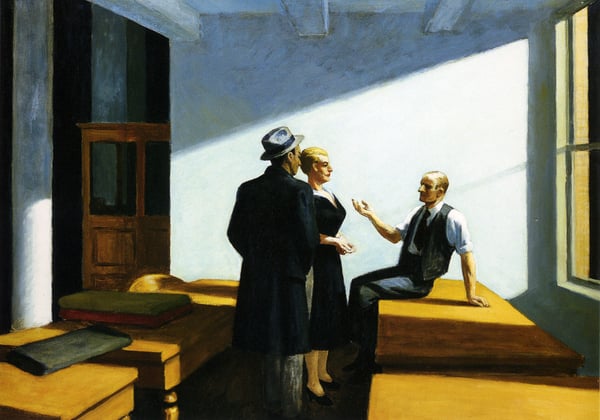
Conference At Night
Détails
Analyse experte de Conference At Night de Edward Hopper
Style : New Realism · Genre : genre painting
Expert Analysis: "Conference At Night" by Edward Hopper (New Realism)
Edward Hopper’s "Conference At Night" (1949) stands as a quintessential example of New Realism, a mid-20th-century American movement that rejected abstraction in favor of sharp, unflinching depictions of contemporary life. As a genre painting, it transforms an ordinary office meeting into a psychological tableau, revealing the isolation and quiet tension that lie beneath the surface of modern professionalism.
Composition and Lighting: Hopper masterfully uses artificial light to define space and mood. The harsh, unshaded overhead lamp casts stark shadows and creates a claustrophobic box of light against the dark office interior. This theatrical illumination isolates the three figures—two men standing, one woman seated at a desk—emphasizing their physical proximity yet emotional distance. The diagonal lines of the desk and the open door in the background frame the scene while hinting at an inscrutable narrative beyond the frame.
Psychological Tension: True to Hopper’s signature, the figures do not engage directly; their gazes are averted or fixed on papers, suggesting unspoken conflicts or weary routine. The woman’s back is partly turned, her posture guarded, while the standing men loom in postures of control or impatience. The title "Conference" implies collaboration, but the atmosphere is one of estrangement—a hallmark of Hopper’s critique of urban anonymity.
Significance within New Realism: "Conference At Night" exemplifies how New Realism used banal settings to probe deeper social truths. Unlike earlier Realism’s focus on labor or poverty, Hopper captures the quiet despair of middle-class life. The work’s stark geometry, muted palette (greens, browns, and yellows), and voyeuristic perspective invite viewers to become silent witnesses. It is a landmark of the style for its ability to make stillness speak volumes—a quiet revolution in genre painting that continues to influence film noir and contemporary visual storytelling.
Museum / Gallery
Visuellement similaire
20 œuvres à la composition et à la palette proches
Hotel By A Railroad
Edward Hopper
Excursion into Philosophy
Edward Hopper
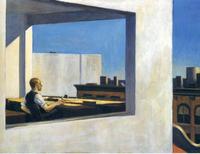
Office in a Small City
Edward Hopper
Cold, Cold Hearts
Jack Vettriano
Sentimental
Goran Djurovic
The Family
Paula Rego
Summer in the City
Edward Hopper
Hotel Lobby
Edward Hopper
Police raid
George Pemba
Morning Sun
Edward Hopper
Hotel Window
Edward Hopper
Room in New York
Edward Hopper
The Barber Shop
Edward Hopper
Mamut's Café
Nicolae Darascu
Intimate Couple in Interior
Felix Vallotton
Evening Reading
Philip Evergood
The cardgame
Balthus
Mirror
Goran Djurovic
Night Life
Robert Spencer
Krefeld Project Living Room Scene 3
Eric Fischl