Analisi esperta di Sea. Gloomy Day di Arkhyp Kuindzhi
Stile: Impressionism · Genere: marina
Expert Analysis: "Sea. Gloomy Day" by Arkhyp Kuindzhi
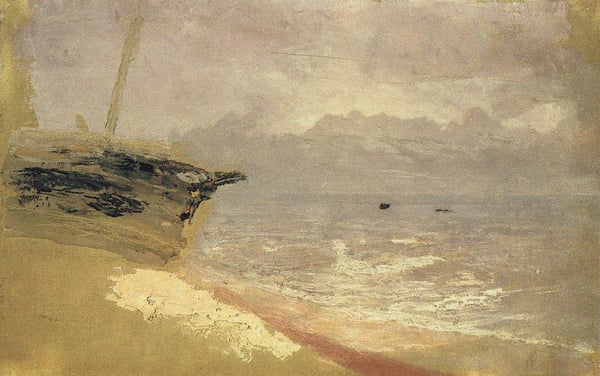
Arkhyp Kuindzhi stands as a singular force within late-19th-century Russian art, and Sea. Gloomy Day exemplifies the painter’s ability to infuse a conventional marine subject with profound emotional and atmospheric weight. Although labeled as Impressionism in style, Kuindzhi’s approach diverges from the French Impressionists’ preoccupation with fleeting optical effects and pure color. Instead, he harnesses the genre’s concern for light and mood to orchestrate a deeply spiritual, almost metaphysical experience of nature.
As a marina, this work places the sea itself at center stage, but Kuindzhi deliberately rejects dramatic waves or heroic sunsets. The “gloomy day” of the title suggests a subdued palette of grays, muted blues, and whites, where the sky and water merge under a heavy, overcast blanket. The significance lies in Kuindzhi’s mastery of tonal harmony and diffused light—qualities that echo Impressionist interest in atmospheric unity, yet serve a different purpose: not to capture the ephemeral moment, but to evoke a state of quiet melancholy and sublime isolation.
What makes Sea. Gloomy Day remarkable within Kuindzhi’s oeuvre is its restraint. Unlike his iconic Moonlit Night on the Dnieper, which bursts with phosphorescent glow, this marine view relies on subtle gradations of value and the almost imperceptible suggestion of a vanishing horizon. The sea appears hushed, its surface a textured expanse of subdued blues and greens that seem to breathe with the weight of the cloudy sky. This interplay between the literal gloom and an inner luminosity—a signature of Kuindzhi—transforms a simple seascape into a meditation on the union of water and air, on the quiet power of diffuse light.
In the context of Russian Impressionism, Kuindzhi stands apart for his symbolic use of color and his ability to draw the viewer into a contemplative state. Sea. Gloomy Day is not merely a record of a dull weather; it is an emotional landscape where the “gloom” becomes a vehicle for introspection, anticipating the poetic realism that would later emerge in Russian art. The work’s enduring significance lies in how it redefines the marina genre—not as a showcase for technical virtuosity, but as a window onto the silent, vast emotional terrain of the natural world.
Visivamente simili
20 opere con composizione e palette affini
Berck, The Beach at Low Tide
Eugene Boudin
Sunset, Hastings. Beached Fishing Vessels
David Cox
Noordzee met bootjes en duinen
Louis Artan
Fishing Boat
Eugene Boudin
Brighton Beach
John Constable
Noordzee met bootjes en duinen
Louis Artan
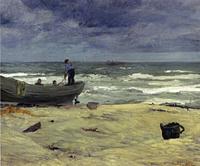
Gray Day, Jersey Coast
John French Sloan
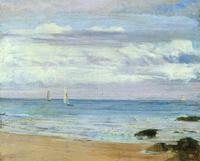
Blue and Silver Trouville
James McNeill Whistler
Delaware River Scene
Thomas Eakins
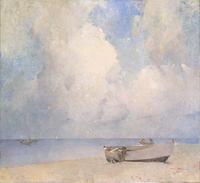
The South Strand
Emil Carlsen
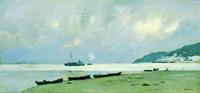
Yurievets. Gloomy Day on the Volga.
Isaac Levitan
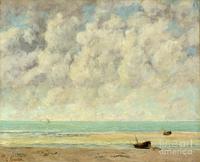
The Calm Sea
Gustave Courbet
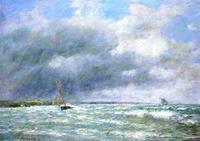
The Stranded Boat
Eugene Boudin
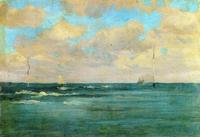
Bathing Posts
James McNeill Whistler
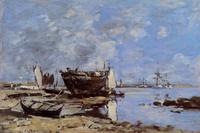
Plougastel, the Ferry Passage
Eugene Boudin
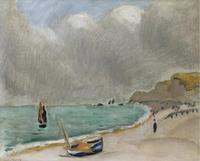
Le Rivage, Etretat
Henri Matisse
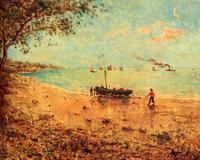
A Beach In Normandy
Alfred Stevens
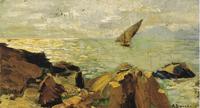
Cliffs in Sestri Levante
Amedeo Bocchi
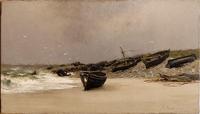
AFTER A SQUALL
Emile Renouf
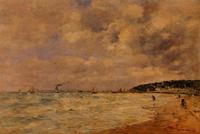
The Tourgeville Shores
Eugene Boudin