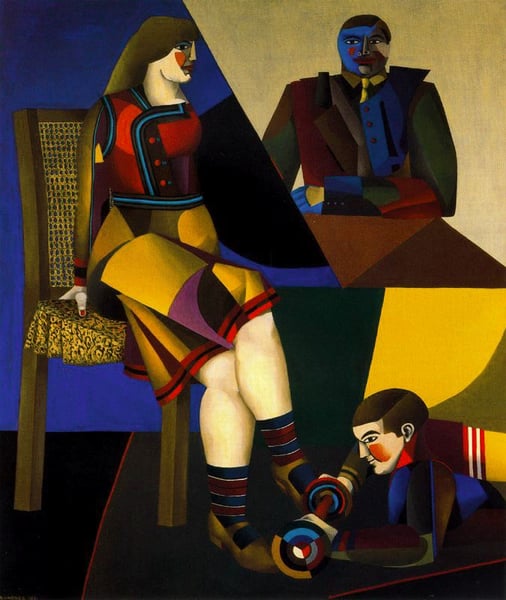
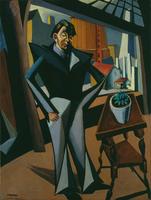
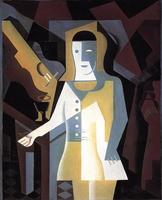
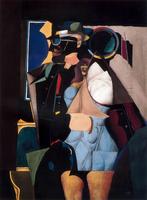
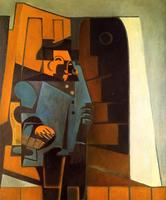
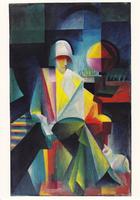
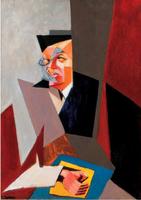
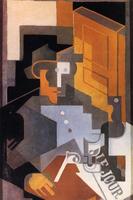
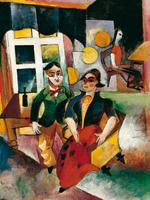
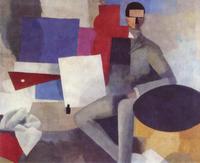
In "The table," Richard Lindner merges the fragmented geometries of Cubism with a cold, industrial precision, exemplifying the distinctive approach of Mechanistic Cubism. As a genre painting, the work takes an ordinary domestic scene—a table—and transforms it into a disquieting, engineered tableau. Lindner’s significance lies in his ability to infuse traditional subject matter with a machine-age aesthetic, where human forms and objects are rendered as interlocking, metallic components. This synthesis not only extends Cubism’s formal innovations into new, psychologically charged territory but also critiques the dehumanizing effects of modern industrialization, marking a pivotal moment where high modernism confronts the mechanized world.