Disneyland
Analisi esperta di Disneyland di Richard Lindner
Stile: Mechanistic Cubism · Genere: genre painting
Expert Analysis of Richard Lindner’s Disneyland
Style: Mechanistic Cubism | Genre: Genre Painting
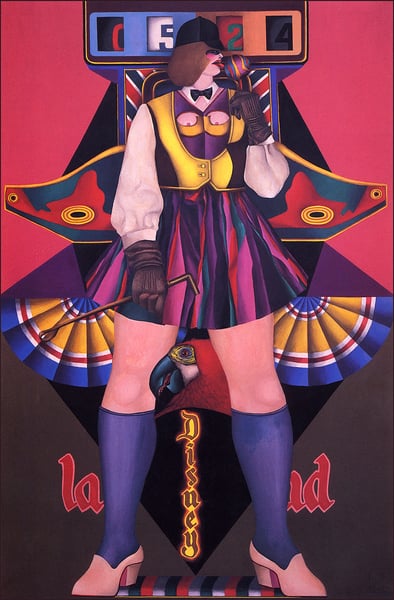
Richard Lindner’s Disneyland stands as a quintessential example of Mechanistic Cubism, a subversive hybrid that fuses the geometric fragmentation of early Cubism with the cold, industrial precision of machine-age aesthetics. As a genre painting, it depicts a scene of modern leisure—the iconic theme park—but transforms it into a chilling critique of mass entertainment and dehumanization.
Significance within Mechanistic Cubism:
Lindner pushes Cubist principles beyond still life and portraiture into a narrative of societal mechanization. The composition fractures human figures into blocky, robotic forms—cylinders, cubes, and angular planes—that echo both the mannequin-like artificiality of department-store dummies and the rigid geometry of factory machinery. Color is flattened and applied with hard edges, often in primary shades (red, blue, yellow), evoking the garish boldness of pop culture signage. Yet unlike pure abstraction, Lindner retains recognizable subject matter: a caricature of Disneyland’s controlled, sanitized fantasy.
Contribution to Genre Painting:
By choosing a quintessentially American leisure setting, Lindner subverts the traditional genre painting’s focus on everyday life. Here, “everyday” becomes a dystopian spectacle—figures appear as gloved, corseted, or armless automatons, their vacant stares and rigid poses suggesting the loss of individual identity within the theme park’s engineered wonder. The painting functions as a social document of the 1960s-70s, critiquing consumer culture’s reduction of humans to cogs in a commercial machine.
Legacy:
Disneyland exemplifies how Mechanistic Cubism could transplant the analytical rigor of Picasso and Braque—their faceted forms and shifting perspectives—into a commentary on modern alienation. Lindner’s work anticipates both Pop Art’s fascination with consumer imagery and the darker tones of later New Objectivity, making this piece a pivotal bridge between high modernism and social critique.
Visivamente simili
20 opere con composizione e palette affini
Thank You
Richard Lindner
42nd Street
Richard Lindner
Man with Parrot
Richard Lindner
Couple
Richard Lindner
The Secret
Richard Lindner
The Child's Dream
Richard Lindner
Jules and Lenny on a Jukebox
Walter Tomasino
Tiger
Peter Phillips
Pierrot (with Serpent)
Heinrich Campendonk
F B I On East69th Street
Richard Lindner
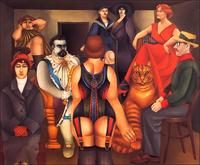
The Meeting
Richard Lindner
Marusya Tchuray
Ivan-Valentyn Zadorozhny
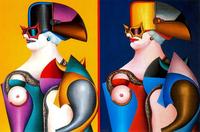
Double Portrait
Richard Lindner
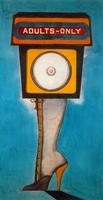
Adults Only
Richard Lindner
Scène Homérique Avec Les Héros
Nikos Engonopoulos
Children's Portraits
Johannes Itten
Costume design for "Venetian madmen" - Colombina
Serge Sudeikin
Urban Chaos.
Erro
Pierrot and Harlequin
Pablo Picasso
Soldat
Gosta Adrian-Nilsson