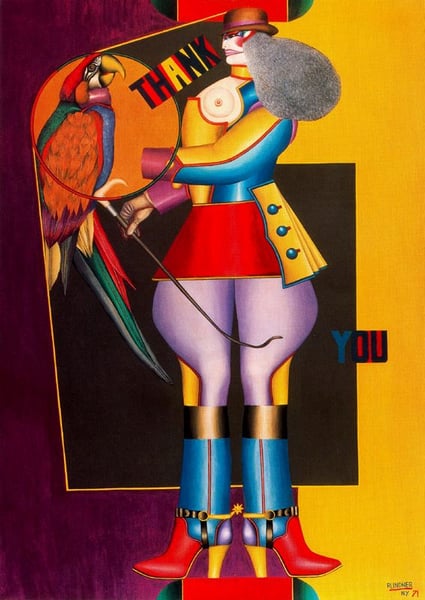
Expertenanalyse zu Richard Lindners Thank You
Stil: Mechanistic Cubism · Genre: genre painting
Expert Analysis of Richard Lindner’s Thank You (Mechanistic Cubism, Genre Painting)
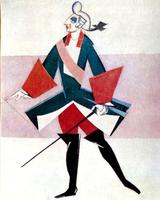
Richard Lindner’s Thank You stands as a defining example of Mechanistic Cubism, a personal synthesis of early Cubist abstraction with the cold, precise geometry of industrial design. Within the tradition of genre painting—scenes of everyday life—Lindner subverts expectations by presenting a contemporary urban encounter as if it were a diagram of human machinery. The work’s significance lies in how it transforms the intimate act of gratitude into a rigid, almost dystopian social ritual, reflecting the alienation and mechanization of modern existence.
Lindner, a German-American painter deeply influenced by the Bauhaus and his work as a illustrator for Vogue and Harper’s Bazaar, populated his canvases with exaggerated, doll-like figures whose bodies are assembled from cylindrical limbs, blocky torsos, and angular faces—a vocabulary borrowed from both Cubist faceting and mechanical drafting. In Thank You, this stylistic choice is not merely formal; it serves as a critical lens. The titular gesture—presumably a polite exchange—is rendered with stiff, architectonic precision, stripping it of warmth. The figures appear as cogs in a social machine, their interaction devoid of spontaneity. The “mechanical” handles, rivets, and metallic coloration further underscore a world where human connections are engineered rather than felt.
As a genre painting, Thank You anchors its commentary in the banal rituals of city life—dining, courtship, passing encounters. But Lindner’s execution elevates it into a pointed critique of mid-20th-century consumer society. By merging the legacy of Cubism (which fractured perspective) with the cold clarity of technical illustration, he creates a style that is both nostalgic for the avant-garde’s radical dismantling of form and forward-looking in its embrace of Pop Art’s fascination with manufactured surfaces. Thank You thus occupies a pivotal moment: it bridges the analytical geometry of Synthetic Cubism with the emerging critique of mass-media imagery, making it a crucial work for understanding how figurative painting adapted to a world increasingly dominated by technology and commerce.
Visuell ähnlich
20 Werke mit ähnlicher Komposition und Farbpalette
Man with Parrot
Richard Lindner
Dressing Gown
Gerda Wegener
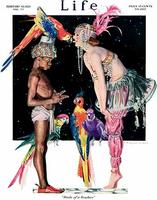
Birds of a Feather
Frank Xavier Leyendecker
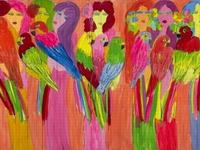
Ladies with Parrots
Walasse Ting
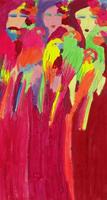
Three Ladies and Parrots
Walasse Ting
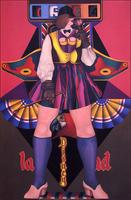
Disneyland
Richard Lindner
Blue Parrots
August Macke
Blue Lady with Parrots
Walasse Ting
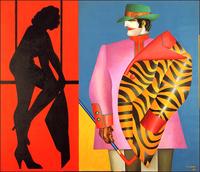
Rear Window
Richard Lindner
Cedric Morris
Frances Hodgkins
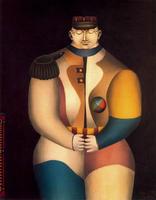
The Juggler
Richard Lindner
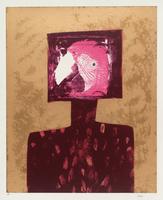
Kelly V
Sidney Nolan
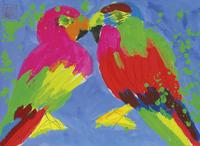
Two Parrots
Walasse Ting
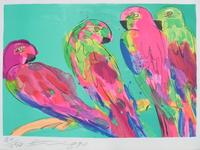
Parrots
Walasse Ting
Fifth Avenue
Richard Lindner
Red Parrot, Green Parrot
Walasse Ting
Laissez les jacasser
Bernard Buffet
The Couple
Richard Lindner

Chagrins D'Amour. Kusaie, Est Carolines
Paul Jacoulet
Costume Design
Vadym Meller