
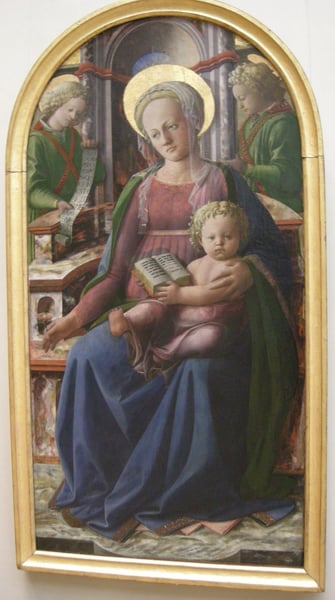
Madonna and Child Enthroned with Two Angels
Details
Expertenanalyse zu Filippo Lippis Madonna and Child Enthroned with Two Angels
Stil: Early Renaissance · Genre: religious painting
Expert Analysis:
Filippo Lippi’s Madonna and Child Enthroned with Two Angels is a defining work of the Early Renaissance (c. 1420–1500), a period that broke from medieval flatness to embrace naturalism, human emotion, and classical spatial clarity. As a religious painting, it serves a devotional purpose, yet Lippi transforms the sacred subject into an intimate, human encounter—a hallmark of the era’s shift toward anthropocentric spirituality.
Significance within Early Renaissance style:
- Humanized divinity: Unlike the rigid, otherworldly Madonnas of Gothic art, Lippi’s Virgin appears as a tender, accessible mother. Her gentle gaze and soft, rounded features reflect the Early Renaissance emphasis on observed humanity, drawing on contemporary ideals of beauty rather than abstract symbolism.
- Spatial innovation: The throne and angels create a three-dimensional, stage-like space—a breakthrough from Byzantine gold-grounds. Lippi employs linear perspective (though not yet mathematically perfect) to organize the composition, guiding the viewer’s eye toward the Christ Child, the theological center.
- Luminous color and light: The vivid blues, reds, and golds are modulated with subtle chiaroscuro, giving the figures sculptural volume. This use of light to model form (derived from Fra Angelico and Masaccio) gives the scene a palpable, airy presence.
- Narrative intimacy: The two angels, often rendered as playful youths in Lippi’s work, flank the throne not as static symbols but as engaged participants—one turning toward the viewer, the other toward the Child. This interactive composition invites the faithful into a personal dialogue with the holy figures.
Why it matters:
Lippi’s Madonna and Child Enthroned with Two Angels exemplifies the Early Renaissance synthesis of divine mystery and earthly realism. It anticipates the High Renaissance’s idealization of nature while retaining the tenderness and decorative grace of the International Gothic tradition. The painting is significant for bridging medieval piety with Renaissance humanism, making the sacred story feel immediate, warm, and emotionally accessible—a core achievement of 15th-century Florentine art.
Museum / Gallery
Visuell ähnlich
20 Werke mit ähnlicher Komposition und Farbpalette
The Virgin and Child surrounded by Five Angels
Sandro Botticelli
Maria and Child
Masaccio
Virgin and Child Enthroned
Carlo Crivelli
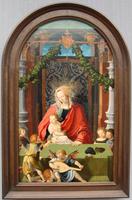
Virgin and Child with Angels
Lucas van Leyden
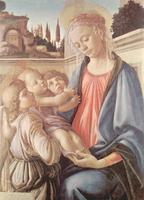
Madonna with two angels
Sandro Botticelli
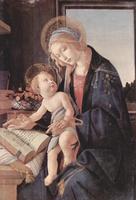
Madonna of the Book
Sandro Botticelli
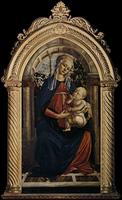
Madonna of the Rosegarden
Sandro Botticelli
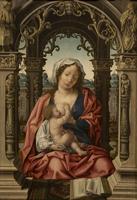
Madonna and Child
Mabuse
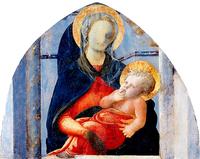
Madonna and Child
Filippo Lippi
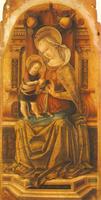
Madonna and Child Enthroned
Carlo Crivelli
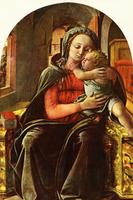
Madonna Enthroned
Filippo Lippi
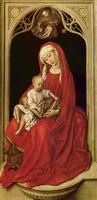
Madonna and Child
Rogier van der Weyden
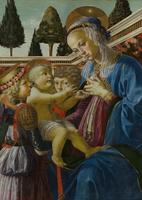
Madonna Lactans
Andrea del Verrocchio
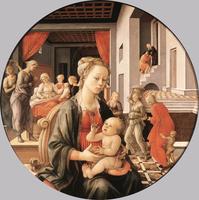
Virgin with the Child and Scenes from the Life of St. Anne
Filippo Lippi
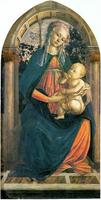
The Madonna of the Roses
Sandro Botticelli
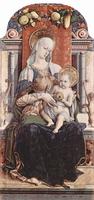
Enthroned Madonna
Carlo Crivelli
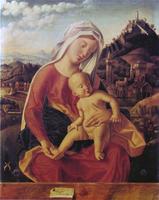
Madonna Con Il Bambino
Bartolomeo Veneto
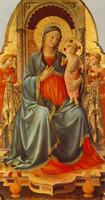
Madonna with the Child and Angels
Fra Angelico
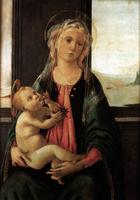
Madonna del Mare
Sandro Botticelli
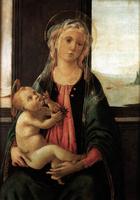
Madonna of the Sea
Sandro Botticelli