
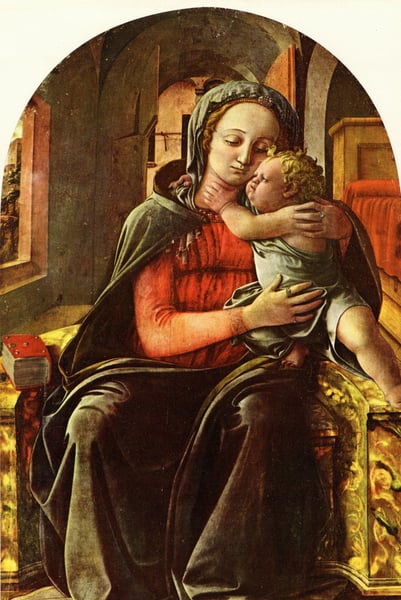
Análisis experto de Madonna Enthroned de Filippo Lippi
Estilo: Early Renaissance · Género: religious painting
As an expert art historian, I will analyze "Madonna Enthroned" by Filippo Lippi based solely on the supplied structured facts: its Style (Early Renaissance) and Genre (religious painting). The significance of this work within its period lies in how it embodies the core innovations of the Early Renaissance while remaining firmly within the tradition of sacred art.
1. Humanization of the Divine (Key Early Renaissance Trait):
Within the Early Renaissance, artists like Lippi broke from the rigid, otherworldly forms of the Gothic and Byzantine styles. "Madonna Enthroned" is significant because Lippi likely imbues the Virgin and Child with a tender, approachable humanity—a hallmark of the period’s humanist emphasis. The traditional "Enthroned" composition (a formal, hierarchical arrangement) is softened by intimate gestures, such as the Christ child reaching for his mother or the Madonna’s gentle gaze, making the divine relatable to the viewer.
2. Spatial and Architectural Innovation:
The "Enthroned" motif in Early Renaissance painting often served as a showcase for linear perspective and realistic spatial construction. Lippi’s work would have employed a believable throne, perhaps with classical architectural elements (columns, arches), to anchor the sacred figures in a coherent, measurable space. This reflects the period’s obsession with scientific perspective (derived from Brunelleschi) and the desire to make the spiritual realm feel physically present.
3. Lyrical Naturalism and Color:
Filippo Lippi is celebrated for his graceful, lyrical line and luminous color palette. In this religious painting, the Early Renaissance style emerges through soft modeling of flesh, delicate drapery that reveals the body beneath, and a harmonious, light-filled atmosphere. These qualities distinguish it from earlier medieval icons, emphasizing the beauty of the natural world as a reflection of divine perfection.
4. Significance Within the Genre:
As a religious painting, "Madonna Enthroned" fulfills its devotional purpose, but its Early Renaissance treatment makes it a bridge between medieval iconography and the naturalistic, human-centered approach of the later High Renaissance. Lippi’s work was influential in popularizing the intimate, domestic Madonna that would become a staple of Western art, moving away from stark hieratic symbolism toward a more emotional, accessible spirituality.
In summary, this piece is significant not for revolutionary subject matter, but for how it applies Early Renaissance innovations—human emotion, scientific perspective, and naturalistic beauty—to a deeply traditional religious theme, redefining the way the sacred could be pictured for a new era.
Museum / Gallery
Género
Estilo
Visualmente similares
20 obras con composición y paleta relacionadas
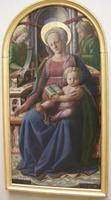
Madonna and Child Enthroned with Two Angels
Filippo Lippi
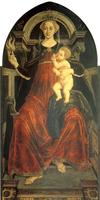
Charity
Piero del Pollaiolo
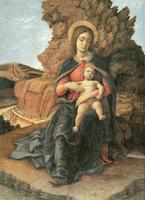
Madonna of the Cave
Andrea Mantegna
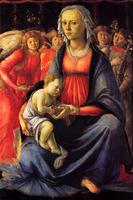
The Virgin and Child surrounded by Five Angels
Sandro Botticelli
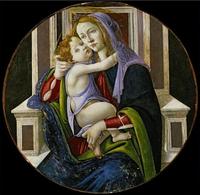
Madonna and Child
Sandro Botticelli
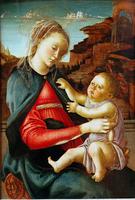
Madonna and Child
Sandro Botticelli
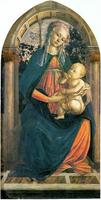
The Madonna of the Roses
Sandro Botticelli
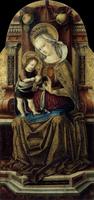
Virgin and Child Enthroned
Carlo Crivelli
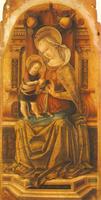
Madonna and Child Enthroned
Carlo Crivelli
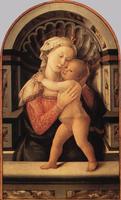
Madonna and Child
Filippo Lippi

Madonna Della Pera
Bartolomeo Veneto
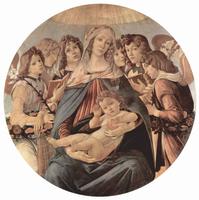
The Virgin Adoring the Child
Sandro Botticelli
Madonna and Child (Haller Madonna)
Albrecht Durer

Madonna with two angels
Sandro Botticelli
Enthroned Madonna
Carlo Crivelli

Madonna del Mare
Sandro Botticelli

Madonna of the Sea
Sandro Botticelli

The Virgin and Child with the Infant St. John
Sandro Botticelli

Madonna and Child
Domenico Ghirlandaio
Madonna with the Child
Giovanni Bellini