
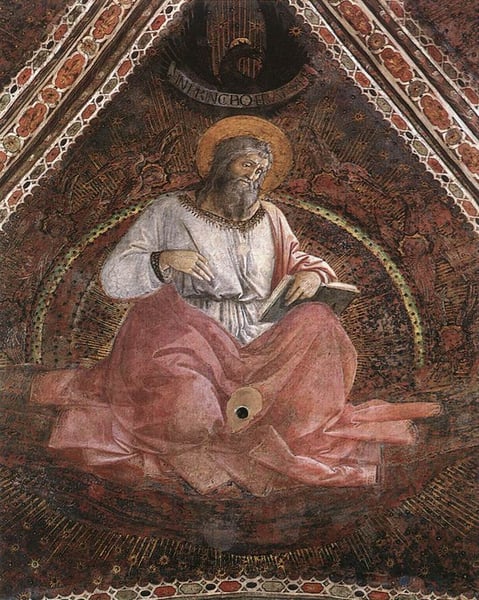
Analisi esperta di St. John the Evangelist di Filippo Lippi
Stile: Early Renaissance · Genere: religious painting
Expert Analysis: "St. John the Evangelist" by Filippo Lippi
As an early Renaissance religious painting, Filippo Lippi’s St. John the Evangelist exemplifies the period’s shift from the flat, stylized forms of Gothic art toward a more naturalistic, human-centered spirituality. Lippi, a Carmelite friar and a master of the Florentine school, was deeply influenced by Masaccio’s volumetric modeling and Fra Angelico’s serene grace. In this work, St. John—typically depicted as the youthful, contemplative apostle—is rendered with a soft, lifelike presence that invites intimate devotion rather than distant awe.
Significance within the Early Renaissance:
- Humanized Sanctity: Lippi breaks from the iconic, otherworldly saint of medieval tradition. Here, St. John’s gentle gaze, refined features, and relaxed posture reflect a psychological realism that makes the divine accessible. The careful rendering of light across the face and drapery, achieved through chiaroscuro, gives the figure a sculptural weight while preserving a tender, lyrical quality.
- Narrative Through Gesture: Though a single-figure devotional image, Lippi imbues the saint with narrative cues—likely a book or a quill (attributes of the Evangelist) that connect him to his Gospel. This combination of emblem and emotion marks a Renaissance interest in individual character and story.
- Technical Innovation: The painting’s use of linear perspective (common in Lippi’s altarpieces) and delicate color harmonies anticipates the later achievements of Botticelli and Leonardo. The warm, naturalistic flesh tones and the luminous background halo, rendered as a subtle disk rather than a flat gold leaf, show Lippi’s engagement with atmospheric space and optical truth.
Broader Context:
Lippi’s St. John is significant because it bridges the devotional function of religious art with the Renaissance humanist ethos. It does not merely instruct the faithful but moves them through empathy and beauty. The saint appears as a thoughtful, gentle figure, reflecting Lippi’s own reputation for combining spiritual reverence with worldly charm—a hallmark that made his work highly sought after by both the Church and the Medici.
In sum, this painting is a quintessential example of how Early Renaissance artists transformed religious subjects into vehicles for exploring human emotion, naturalism, and compositional harmony, laying the groundwork for the High Renaissance masters.
Visivamente simili
20 opere con composizione e palette affini
St. Luke the Evangelist
Filippo Lippi
St. Matthew the Evangelist
Domenico Ghirlandaio
View of the chapel vaulting
Fra Angelico
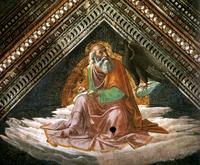
St. John the Evangelist
Domenico Ghirlandaio
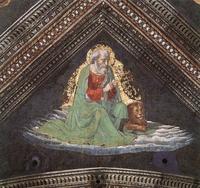
St. Mark the Evangelist
Domenico Ghirlandaio
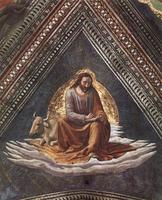
St. Luke
Domenico Ghirlandaio
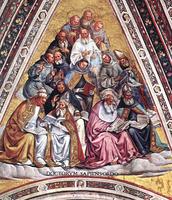
Doctors of the Church
Luca Signorelli

A Sibyl
Domenico Ghirlandaio
St. Mark (detail of The Four Evangelists)
Benozzo Gozzoli
St. John (detail of The Four Evangelists)
Benozzo Gozzoli
St. Luke (detail of The Four Evangelists)
Benozzo Gozzoli
Prophets
Fra Angelico
Martyrs and Saint Virgins
Luca Signorelli
The Birth and Infancy of St. Stephen (detail)
Filippo Lippi
Christ the Judge
Fra Angelico
Ceiling Frescoes in the Chapel of San Brizio
Luca Signorelli
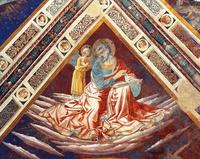
St.Matthew (detail of The Four Evangelists)
Benozzo Gozzoli
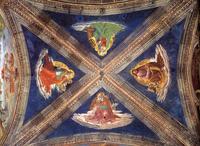
Vaulting of the Tornabuoni Chapel
Domenico Ghirlandaio
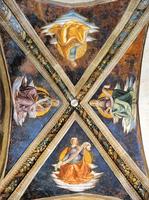
Vaulting of the Sassetti Chapel
Domenico Ghirlandaio
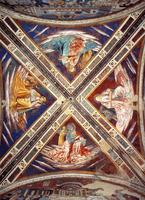
The Four Evangelists
Benozzo Gozzoli