
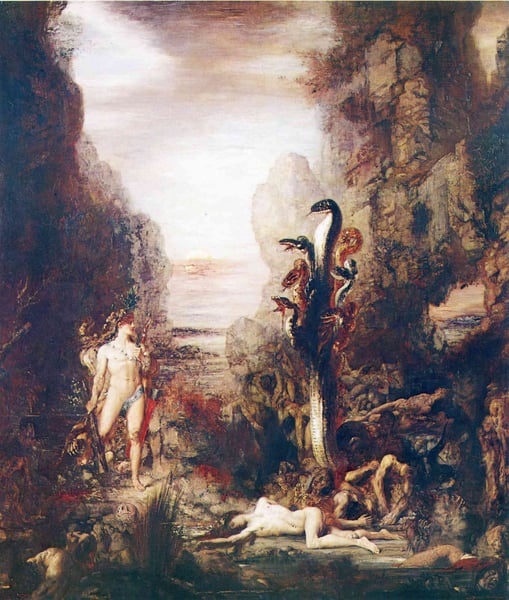
Analisi esperta di Hercules and the Hydra Lernaean di Gustave Moreau
Stile: Symbolism · Genere: mythological painting
Expert Analysis: Hercules and the Hydra Lernaean by Gustave Moreau
Gustave Moreau’s Hercules and the Hydra Lernaean stands as a quintessential masterpiece of the Symbolist movement, transforming a familiar mythological episode into a deeply introspective and dreamlike allegory. While the subject—Hercules’ second labor—is rooted in classical narrative, Moreau’s treatment elevates it beyond mere illustration into a meditation on inner struggle, the nature of evil, and the artist’s own psychological landscape.
Significance within Symbolism:
Moreau eschews the dynamic, heroic action typical of academic or Renaissance depictions (e.g., by Antonio del Pollaiuolo or Peter Paul Rubens). Instead, he focuses on a static, almost ritualistic confrontation. Hercules is not shown mid-strike but poised in tense stillness, his gaze inward rather than on the hydra. This shift from physical prowess to psychological tension is a hallmark of Symbolism: the monster becomes a symbol of the many-headed nature of human vices, doubts, or the subconscious—an infinite, regenerative evil that must be confronted not with brute force alone but with spiritual resolve.
Visual and Stylistic Innovations:
Moreau employs a jewel-toned palette and intricate, almost mosaic-like detailing—ornate armor, luminous flesh, and a fantastical, cavernous landscape that feels both ancient and otherworldly. The hydra itself is rendered with eerie, serpentine elegance, its heads entwined in a deadly dance. This decorative richness is not mere ornament; it creates a sacred, hieratic atmosphere, turning the canvas into a kind of visionary icon. The composition is deliberately claustrophobic, with the writhing hydra filling the foreground, emphasizing the overwhelming, all-consuming nature of the evil Hercules must overcome.
Contribution to Moreau’s Legacy:
This painting exemplifies Moreau’s role as a bridge between Romanticism and the emerging Symbolist movement, and a profound influence on later artists such as Odilon Redon and the Surrealists. By reimagining Hercules’ labor as a solitary, introspective ordeal rather than a triumph of physical strength, Moreau redefines heroism as an internal, spiritual battle. The work’s significance lies in its refusal to provide easy narrative clarity; instead, it invites the viewer to project their own fears and struggles onto the myth, making the ancient story profoundly modern and personal.
In summary, Hercules and the Hydra Lernaean is significant not only for its technical mastery and sumptuous style but for its radical reinterpretation of myth as a vehicle for Symbolist expression—a quiet, haunting confrontation that resonates far beyond the canvas.
Museum / Gallery
Visivamente simili
20 opere con composizione e palette affini

Perseus and Andromeda
Jan Brueghel the Elder

Water
Jan Brueghel the Elder
Perseus and Andromeda
Gustave Moreau
Transformation into Snakes
Gustave Dore
Perseus and Andromeda
Titian

The Four Elements, Water
Jan Brueghel the Younger
Perseus Rescuing Andromeda
Joachim Wtewael
Diana and Actaeon
Thomas Gainsborough
Apollo Vanquishing the Serpent Python
Gustave Moreau

Pasiphae and the Bul
Gustave Moreau
The Summer Diana Surprised by Actaeon
Eugene Delacroix

Allegory of Water
Jan Brueghel the Elder

Pentheus pursued by the Maenads
Charles Gleyre
Perseus and Andromeda
Gustave Moreau

The Spring of Love
Arnold Böcklin
Triton and Nereid
Arnold Böcklin

Landscape with Nymphs
Jan Dirksz Both

The Education of Achilles
Gustave Moreau
Hercules at Lake Stymphalos
Gustave Moreau
The Sphinx Defeated
Gustave Moreau