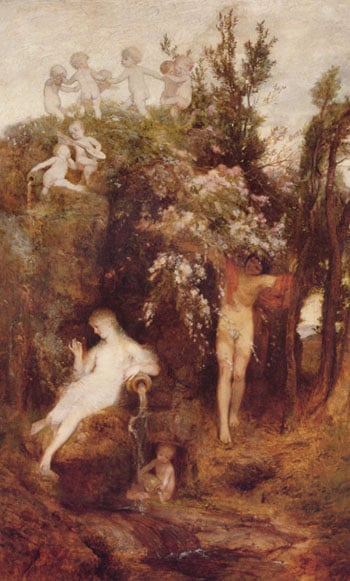
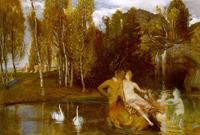
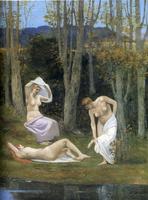
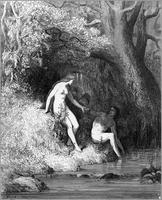
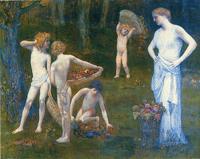
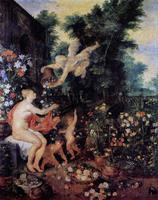
"The Spring of Love" by Arnold Böcklin is a quintessential allegorical painting within the Symbolist movement. Its significance lies in how Böcklin embodies Symbolism’s core goal: conveying emotional and metaphysical truths through mythic, dreamlike imagery rather than literal representation. As an allegory, the artwork uses personified figures and natural motifs—such as a spring or lovers—to explore universal themes of love, renewal, and the cyclical forces of life. Böcklin, a master of mood and atmosphere, infuses the scene with a haunting, timeless quality that reflects Symbolism’s rejection of realism and its turn toward the subconscious and the ideal. The painting thus stands as a key example of how Symbolist artists transformed traditional allegory into a vehicle for modern, introspective exploration.