Expertenanalyse zu Aleksey Savrasovs Oaks
Stil: Realism · Genre: landscape
Expert Analysis: "Oaks" by Aleksey Savrasov
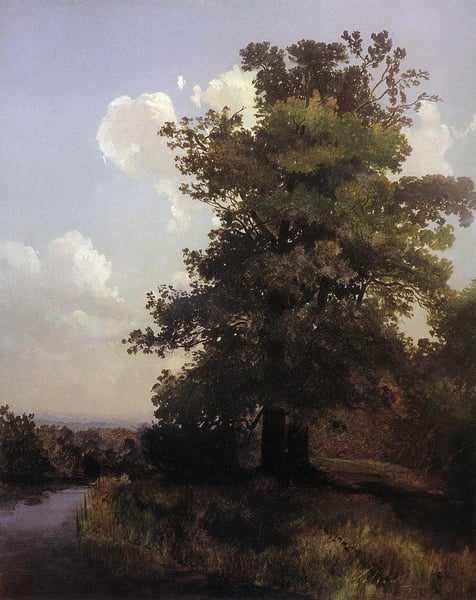
Aleksey Savrasov’s Oaks stands as a quintessential example of Russian Realist landscape painting, embodying the movement’s shift from idealized, academic vistas to a deeply personal, truthful portrayal of nature. Painted in the latter half of the 19th century, this work reflects Savrasov’s role as a foundational figure of the Peredvizhniki (The Wanderers), a group that championed art rooted in national identity and emotional sincerity.
Significance within Realism and Genre
Savrasov’s Oaks achieves significance through its quiet, unpretentious observation of the natural world. Unlike the dramatic, often romanticized landscapes of earlier generations, Savrasov focuses on a humble, intimate scene: a cluster of oak trees, likely in a field or forest edge of the Russian countryside. The composition is straightforward, devoid of grand narratives or rhetorical flourishes. This restraint is a hallmark of Realist ideology—elevating the everyday, the ordinary, and the authentic.
Technical and Emotional Depth
The painting’s power lies in Savrasov’s ability to capture atmospheric nuance. He renders the oak trees with careful attention to their individual bark textures, branching patterns, and the play of light filtering through the leaves. The palette is subdued, earthy—shades of green, brown, and soft gray—evoking the fleeting, changeable weather of the Russian landscape. This is not an eternal, heroic forest but a specific moment in time: perhaps a cloudy afternoon or early autumn, where the air feels still and heavy with moisture.
Savrasov’s brushwork is both delicate and vigorous: the foliage is built up with small, layered strokes that suggest movement and vitality, while the trunks are painted with a firm, grounded solidity. This tension between life and permanence gives Oaks a contemplative, almost melancholic mood—a hallmark of Savrasov’s work, famously seen in his masterpiece The Rooks Have Come Back (1871). Here, the oaks become symbols of resilience and quiet endurance, rooted in the soil of a nation awakening to its own identity.
Context and Legacy
Oaks is significant not only for its aesthetic merit but for its place in the evolution of Russian landscape painting. Savrasov influenced successors like Isaac Levitan, who would later achieve even greater fame with similar lyrical treatments of nature. By turning his gaze to a simple grove of oaks, Savrasov asserted that profound beauty and national spirit could be found not in foreign Alps or classical ruins, but in the unassuming corners of one’s own homeland. This democratization of subject matter—a core Realist principle—made the landscape genre a vehicle for emotional and political expression in Russian art.
In Oaks, Savrasov invites the viewer to stand still, feel the cool air, and listen to the rustle of leaves. It is a quiet masterpiece—a meditation on the sacredness of the ordinary, and a testament to how truth, observed with humility, becomes timeless.
Visuell ähnlich
20 Werke mit ähnlicher Komposition und Farbpalette
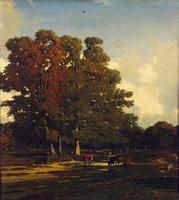
Autumn Landscape
Jules Dupre
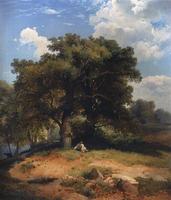
Landscape with oak trees and shepherd
Aleksey Savrasov
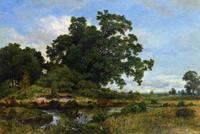
Study at Orange County, New York
David Johnson
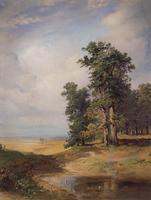
Summer landscape with oaks
Aleksey Savrasov
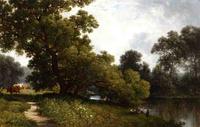
On the Waywayanda, Orange County, New York
David Johnson
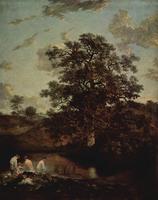
The Poringland Oak
John Crome
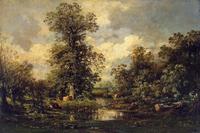
Forest Landscape
Jules Dupre
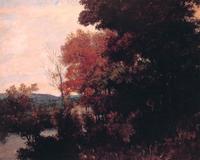
In the Forest
Gustave Courbet
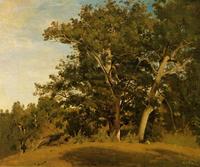
Fountainebleau With Georges d'Apremont
Camille Corot
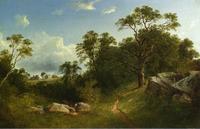
Landscape
David Johnson
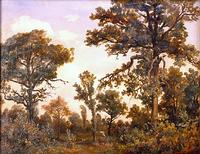
The Large Oak Tree, Forest of Fontainebleau
Theodore Rousseau
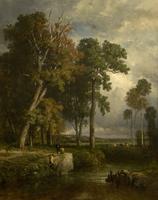
The Angler
Constant Troyon
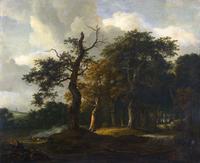
A Road through an Oak Wood
Jacob van Ruisdael
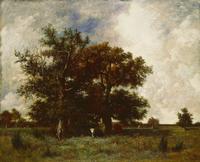
Fontainebleau Oaks
Jules Dupre
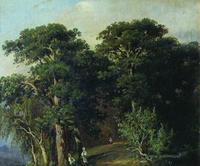
Forest Landscape with Figures
Ivan Shishkin
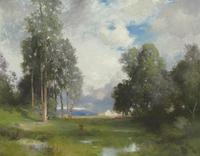
Santa Barbara Mission
Thomas Moran
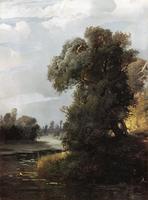
Summer Day
Aleksey Savrasov
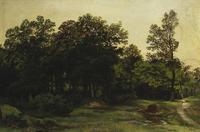
Deciduous Forest
Ivan Shishkin
The Forest Edge
Gustave Courbet
Dutch Landscape
Frans Arnold Breuhaus de Groot