Analisi esperta di Summer Day di Aleksey Savrasov
Stile: Realism · Genere: landscape
Expert Analysis of "Summer Day" by Aleksey Savrasov
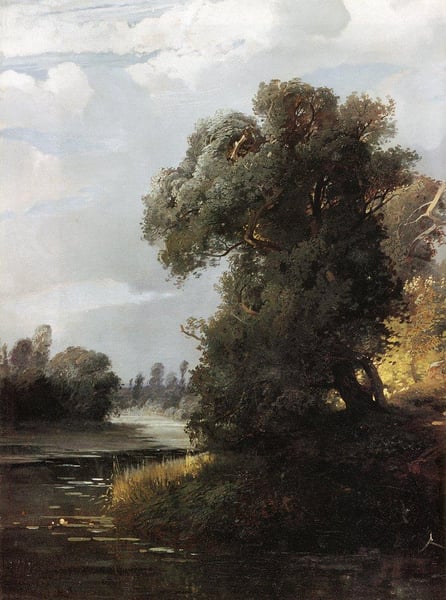
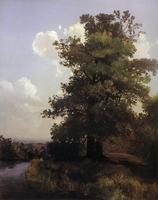
Aleksey Savrasov’s “Summer Day” stands as a quintessential example of Russian Realist landscape painting, demonstrating the artist’s profound ability to transform a simple, unassuming corner of nature into a deeply lyrical and emotionally resonant scene. While the subject appears straightforward—a sunlit, rural expanse under a high summer sky—the work is significant for several reasons that anchor Savrasov’s legacy within both the Russian Realist movement and the broader history of landscape art.
1. The Poetics of the Ordinary
Savrasov, a founding member of the itinerant Peredvizhniki (The Wanderers), rejected the idealized, often monumental landscapes favored by academic painting. Instead, he focused on the quiet, unheroic moments of Russian nature. In “Summer Day,” there is no dramatic mountain or stormy sea; there is only an open field, scattered trees, and the soft, diffused light of a midday sun. This deliberate simplicity elevates the mundane to the sublime. Savrasov’s genius lies in his capacity to find an intimate, almost spiritual beauty in the vastness of the Russian plain—a quality that influenced later masters like Isaac Levitan.
2. Mastery of Light and Atmosphere
Executed with a nuanced palette of greens, yellows, and warm earth tones, the painting captures the transient, shimmering quality of summer light. Savrasov was a pioneer in plein air painting in Russia, and “Summer Day” demonstrates his acute observation of natural phenomena: the slight haze on the horizon, the soft shadows beneath the trees, and the way sunlight filters through foliage. This atmospheric realism—rooted in direct observation rather than studio convention—gives the scene a palpable sense of time and place, making the viewer feel the warmth of the season.
3. Emotional Depth and National Identity
For Savrasov, the Russian landscape was not merely a topographic record but a vessel for national sentiment. “Summer Day” embodies a quiet reverence that resonates with the Russian soul—a sense of harmony, melancholy, and endless space. This emotional underpinning marks a departure from earlier, more decorative or picturesque treatments of the land. Savrasov’s landscapes became icons of a specifically Russian sensibility, celebrated for their sincerity and unpretentious intimacy. The painting thus contributes to a cultural redefinition of nature as a mirror of human feeling, a cornerstone of Realist thought.
4. Technical Innovation within Realism
Savrasov’s brushwork in “Summer Day” is both economical and expressive. He uses broad, loose strokes for the sky and foliage, while retaining finer detail in the foreground grasses and flowers. This balance between sketch-like freedom and descriptive accuracy was influential, allowing later artists to move toward a more impressionistic handling while still honoring the Realist commitment to truthfulness. The composition—a low horizon line that gives prominence to the sky—echoes the vastness of the Russian landscape, a motif Savrasov perfected.
5. Significance in Context
“Summer Day” is representative of the mature phase of Savrasov’s career, when his work was most admired for its lyrical quietude. It reinforces his reputation as “the father of Russian landscape painting,” a title earned for his breakthrough painting “The Rooks Have Come Back” (1871). While the latter work is more famous for its narrative of spring’s return, “Summer Day” offers a serene counterpoint—a celebration of stillness and the fullness of life. Together, these works reveal Savrasov’s remarkable range and his unwavering dedication to capturing the authentic, soulful essence of the Russian countryside.
In summary, “Summer Day” is significant not because it depicts a dramatic spectacle, but because it shows that the most profound art can arise from the simplest observation. Savrasov’s ability to infuse a quiet summer scene with poetic depth, national character, and technical mastery ensures this painting’s enduring place in the canon of 19th-century Russian Realism.
Visivamente simili
20 opere con composizione e palette affini

On the Esopus Creek, Ulster County, New York
David Johnson
Evening Landscape
Aleksey Savrasov
Treescape with pond
Ludwig Richter

Dawn
Fyodor Vasilyev

Sunset on Long Island
Thomas Moran
river landscape with ducks in the foreground
Sidney Richard Percy

Am Fluss große Baumgruppe am Ufer eines gemächlich dahin fließenden Flusses in flacher Landschaft, mit Angler und einem Paar Schwänen, unter luftig bewölktem Himme
Johann Wilhelm Schirmer
On the Escopus at Hurley, New York
David Johnson

A Long Island River
Thomas Moran
Upper Yarra
Isaac Whitehead
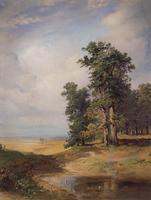
Summer landscape with oaks
Aleksey Savrasov
On the Waywayanda, Orange County, New York
David Johnson
Travellers in a wooded landscape near a river
Eduard Boehm
Forest Landscape
Jules Dupre
A wooded landscape on the edge of a lake
Thomas Barker of Bath
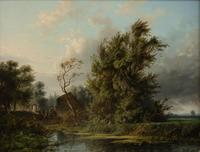
Dutch landscape with figures at work near a farm by the water
Jan Willem van Borselen
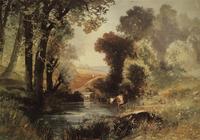
Summer Landscape
Aleksey Savrasov
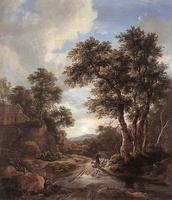
Sunrise in a Wood
Jacob van Ruisdael
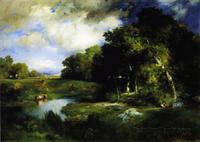
Pastoral Landscape
Thomas Moran
Oaks
Aleksey Savrasov