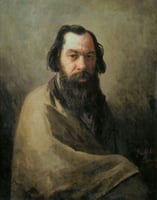
Expertenanalyse zu Aleksey Savrasovs Swiss View
Stil: Realism · Genre: landscape
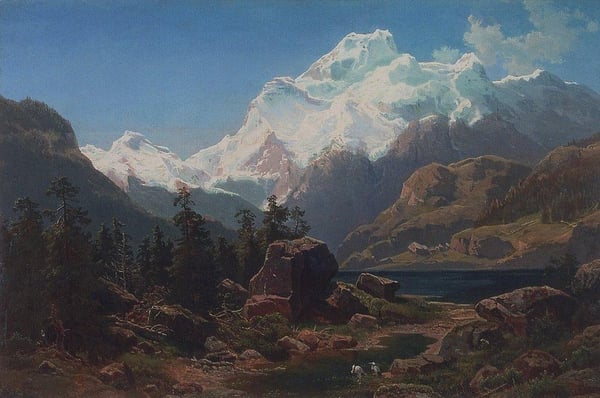
Expert Analysis of Swiss View by Aleksey Savrasov
As a master of Russian Realism and a key figure in the Peredvizhniki (Wanderers) movement, Aleksey Savrasov is celebrated for infusing landscape painting with profound emotional sincerity and a keen observation of nature. In Swiss View, he applies these same principles to an Alpine subject, demonstrating the universality of Realist vision.
Significance within Realism and Landscape Tradition:
- Lyrical Realism Beyond National Borders: While Savrasov is best known for his quintessentially Russian scenes—most notably The Rooks Have Come Back—Swiss View proves his ability to capture the distinct character of a foreign landscape without resorting to romantic idealization. Instead of treating the Swiss Alps as a picturesque cliché, he observes them with the same unflinching yet sensitive eye he turned on the Russian countryside. This reinforces the core Realist tenet: truth to the specific character of place, whether a humble Russian thaw or a dramatic Alpine vista.
- Atmospheric Truth and Emotional Resonance: The painting likely prioritizes atmospheric effects—the quality of light over the peaks, the humidity in valleys, the texture of rock and vegetation. Savrasov was a master of rendering subtle transitions in weather and season, and Swiss View would showcase this by balancing the grandeur of the Alps with the intimate details of foreground terrain. The significance lies in how he humanizes a potentially overwhelming subject; the landscape feels accessible and emotionally potent rather than merely sublime.
- Technical and Historical Context: Created during a period when Russian artists were traveling abroad more frequently, Swiss View reflects a cross-pollination of European Realism and Russian sensitivity. Savrasov’s brushwork likely combines precise draftsmanship (necessary for geological accuracy) with a looser, more painterly handling of skies and foliage—a hallmark of his mature style. The work stands as a testament to Realism’s ability to find profound beauty in any corner of the natural world, stripped of allegory but rich in authenticity.
In essence, Swiss View is significant not because it departs from Savrasov’s typical themes, but because it proves that his lyrical, truth-seeking gaze could make even an iconic Alpine scene feel fresh, intimate, and deeply observed—expanding the emotional vocabulary of landscape Realism.
Visuell ähnlich
20 Werke mit ähnlicher Komposition und Farbpalette
Swiss Landscape
Aleksey Savrasov
The Teton Range
Thomas Moran
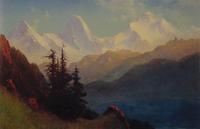
Splendour of the Grand Tetons
Albert Bierstadt
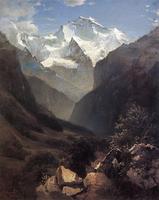
View of the Swiss Alps (Mount Small Ruhen)
Aleksey Savrasov
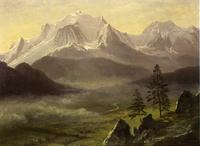
Grand Tetons
Albert Bierstadt
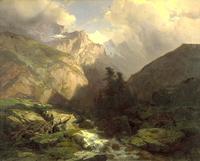
The Jungfrau, Switzerland
Alexandre Calame
Mountain Scene
Albert Bierstadt
[Unkown]
Alexandre Calame
The Morteratsch Glacier, Upper Engadine Valley, Pontresina
Albert Bierstadt
Landscape
Albert Bierstadt
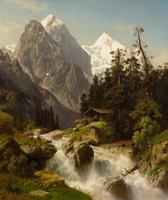
Alpine Waters
Johann Joseph Jansen
Index Peak
Thomas Moran
Mount Hood, Oregon
Albert Bierstadt
Index Peak Yellowstone National Park
Thomas Moran
Die Ortlergrupper von der Malserhaide aus gesehen, im Vordergrund Hirtin mit ihrer Kuhherde
Carl Millner
Vierwaldstättersee Mit Blick Auf Die Tellkapelle
Hermann Ottomar Herzog
Paysage de montagne en Bavière
Giulio Lange
Prometheus Bound
Thomas Cole
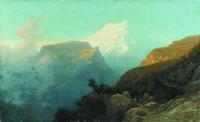
Mist in the mountains. Caucasus.
Lev Lagorio
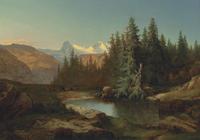
Ruin Unspunnen in front of the view of Eiger, Mönch and Jungfrau
Alexandre Calame