Expertenanalyse zu Aleksey Savrasovs Volga near Gorodets
Stil: Realism · Genre: landscape
Expert Analysis: "Volga near Gorodets" by Aleksey Savrasov
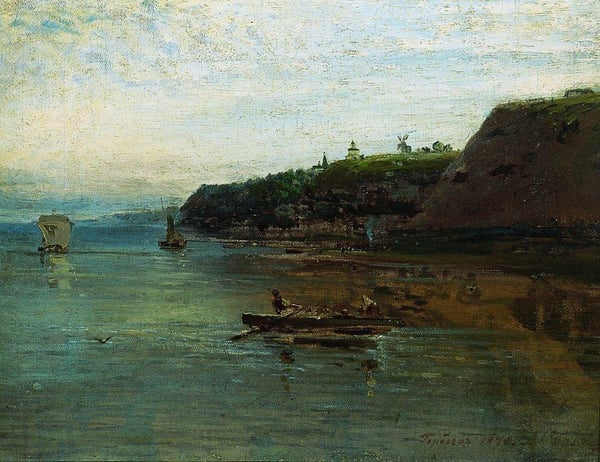
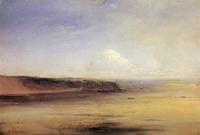
Aleksey Savrasov’s Volga near Gorodets stands as a quintessential example of Russian Realist landscape painting, embodying the movement’s deep commitment to truthfully depicting native scenery while imbuing it with poetic emotion. Painted during the artist’s mature period, this work demonstrates the core principles of the Peredvizhniki (The Wanderers), the progressive group with which Savrasov was closely associated: a rejection of idealized, academic landscapes in favor of direct observation and an intimate, often melancholy connection to the land.
Significance within the Realist Style and Period
-
Lyrical Naturalism: Savrasov is celebrated for transforming the Russian landscape from a mere backdrop into a vessel for national identity and spiritual reflection. In Volga near Gorodets, he captures the vast, open expanse of the Volga River under a translucent, overcast sky. The muted palette—soft grays, pale blues, and earthy browns—is typical of his realism, avoiding dramatic theatricality. Instead, he conveys the quiet, humid atmosphere of the Russian heartland, where the river seems to breathe and the horizon dissolves into a soft haze. This atmospheric effect is a hallmark of Savrasov’s ability to transpose the transient moods of nature onto the canvas.
-
Emotional Resonance: Unlike the grand, heroic landscapes of earlier Romanticism, Savrasov’s work focuses on the unassuming and the humble. The low horizon line emphasizes the vastness of the sky, while the small fishing boats and indistinct shoreline buildings speak to human presence that is modest and integrated into the natural world. The painting evokes a sense of tranquility tinged with loneliness—a characteristic nastroenie (mood) that Savrasov pioneered and that later influenced artists like Isaac Levitan. This emotional depth elevates the work beyond topographical record; it becomes a meditation on the timeless, often melancholic beauty of rural Russia.
-
Technical Mastery of Realist Principles: Savrasov employed a plein-air approach, studying the effects of light and weather directly from nature. Here, the delicate modulation of tones in the water reflects the shifting cloud cover, while the receding riverbank is rendered with loose, confident brushwork that suggests wet earth and sparse vegetation. The composition is deceptively simple—a diagonal river view leading the eye to the distant shore—yet it is anchored by a careful balance of horizontal and vertical elements (the river’s expanse vs. the slender masts of boats). This clarity and restraint are hallmarks of Savrasov’s later style, moving away from the more detailed, anecdotal approach of his early work.
-
Influence on Russian Landscape Tradition: Volga near Gorodets is significant not only as a standalone masterpiece but as a bridge between the early realism of the 1850s and the more lyrical, expressive landscapes of the late 19th century. Savrasov’s emphasis on capturing the soul of the landscape—rather than its mere appearance—helped establish the Russian school of landscape painting as a vehicle for profound national sentiment. This work, with its restrained palette and atmospheric unity, anticipates the meditative qualities found in the paintings of Levitan, Serov, and later Russian realists.
Conclusion
In Volga near Gorodets, Savrasov achieves an extraordinary synthesis of precise observation and poetic feeling. The painting is a testament to the Realist ideal that art should reflect lived experience, yet it transcends documentation through its serene, almost spiritual resonance. It remains a pivotal work that illustrates how the Russian landscape, even in its most unassuming reaches, could become a subject of profound artistic and cultural significance.
Museum / Gallery
Visuell ähnlich
20 Werke mit ähnlicher Komposition und Farbpalette
On the Hudson, near Dobb's Ferry
Louis Comfort Tiffany
Brest, the Banks of the Harbor
Eugene Boudin
Camaret, Fishermen and Boats
Eugene Boudin
Village on a Dutch Coast
Konstantinos Volanakis
On the Bank of the Volga
Fyodor Vasilyev
Seacoast at Saint-Adresse, Sunset
Claude Monet
Departure Towards the Open Sea
Nicolae Vermont
Boats in a port
Konstantinos Volanakis
Sunset near Glencaple on Solway
James Campbell Noble
Seascape
Louis Artan
Banks of a River with Barge
Camille Pissarro
Brest, the Harbor
Eugene Boudin
Fresh breeze
Arkady Rylov
The Fisherman, Low Tide
Eugene Boudin
Volga
Aleksey Savrasov
Women Fishing for Shrimp at Kerhor
Eugene Boudin
The Beach at Honfleur
Claude Monet
The Coastline at Plougastel
Eugene Boudin
The Sea Viewed from the Heights of Dieppe
Eugene Delacroix
Landscape with brother's figure
Vasily Surikov