Expert analysis of Fyodor Vasilyev’s On the Bank of the Volga
Style: Realism · Genre: landscape
Expert Analysis: "On the Bank of the Volga" by Fyodor Vasilyev
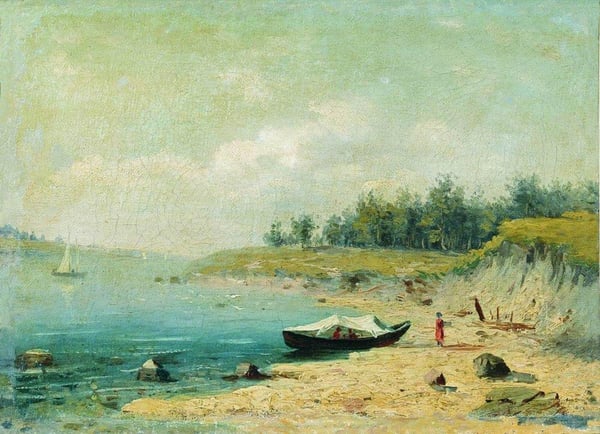
Fyodor Vasilyev’s On the Bank of the Volga (circa 1870) stands as a luminous exemplar of Russian Realist landscape painting, a testament to the artist’s brief but profoundly influential career. Despite his premature death at age 23, Vasilyev captured the emotional and atmospheric depth of the Russian countryside with a sensitivity that elevated landscape from mere topography to a vehicle for national identity and poetic introspection.
Significance within the Realist Movement and Russian Landscape Tradition
-
Lyrical Realism: Vasilyev was a key figure in the Peredvizhniki (The Wanderers), a group that rebelled against academic formalism to depict everyday life and nature with unvarnished truth. Yet his realism is not documentary—it is infused with a melancholic lyricism. In On the Bank of the Volga, the broad, calm river stretches toward a hazy horizon under a sky heavy with clouds. The muted palette of soft greens, ochres, and silvery grays conveys a quiet, almost meditative stillness, reflecting the artist’s ability to render not just a physical location but a mood—a hallmark of his mature style.
-
Innovative Treatment of Light and Atmosphere: Vasilyev’s handling of light is particularly significant. Rather than sharp contrasts, he uses a diffused, atmospheric glow that softens outlines and merges earth, water, and sky. This technique, influenced by the Barbizon school and perhaps the nascent Impressionism he encountered in travels, allows the Volga to appear both immense and intimate. The shimmering reflections on the water’s surface and the subtle gradations of the cloud cover demonstrate his mastery of tonal harmony, a quality that influenced later Russian painters like Isaac Levitan.
-
Cultural and National Resonance: The Volga River held deep symbolic meaning for 19th-century Russia—as a source of life, commerce, and folklore. Vasilyev’s depiction strips away any heroic or picturesque grandeur, instead presenting the river as a quiet, enduring presence. This aligns with the Realist imperative to find profundity in the ordinary, yet it also foreshadows the Symbolist tendencies that would emerge in Russian art. By focusing on a simple bank with sparse vegetation and a lone boat, he invites the viewer to contemplate the vastness and silence of the Russian landscape—a theme that would become central to the nation’s artistic identity.
Artistic Legacy
On the Bank of the Volga is significant as a final, mature work from an artist who died of tuberculosis at 23. In his short career, Vasilyev synthesized the detailed observation of Realism with an emotional resonance that transcended mere depiction. This painting exemplifies his ability to transform a specific geographic location into a universal meditation on time, nature, and solitude. It remains a cornerstone of Russian Realism, demonstrating that the movement’s greatest achievement was not merely in showing what is seen, but in evoking what is felt.
Visually similar
20 works with related composition and palette

Sea shore in the vicinity Oranienbaum
Aleksey Savrasov
Bank of the Volga after the Storm
Fyodor Vasilyev
The Shore. Cloudy Day
Fyodor Vasilyev
Landscape with boat
Aleksey Savrasov

Evening on the Beach of Hellebaek
Anders Andersen-Lundby
A boat
Vasily Polenov
Fjord Landscape with People
Hans Gude
Küstenlandschaft mit Fischern
Anders Andersen-Lundby
Sunset near Glencaple on Solway
James Campbell Noble
Fisherman Boating along a Wooded Landscape
Camille Corot
The Seine in Bezons, Val d'Oise
Charles-Francois Daubigny
Brest, Fishing Boats
Eugene Boudin
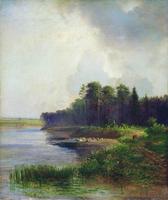
Riverside
Aleksey Savrasov
Landscape
Paul Trouillebert

Seascape
Efim Volkov
At Moscow-river
Isaac Levitan
The River
Konstantinos Volanakis
Summer Landscape
Alexander Kiselyov
Summer Landscape
Aleksandr Kiseliov
Evening at Volga
Isaac Levitan