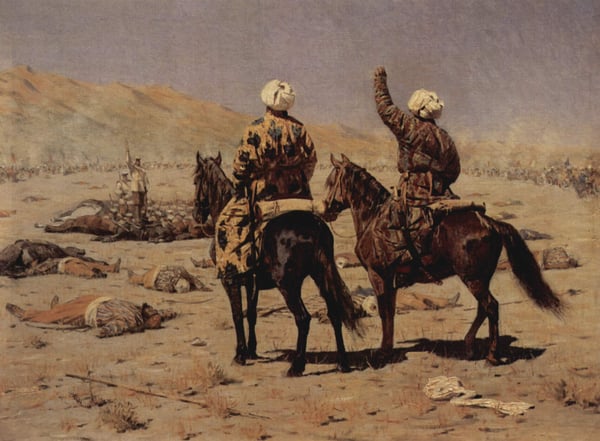
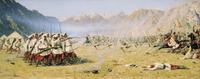
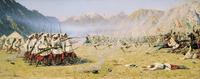
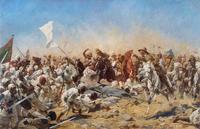
Vasily Vereshchagin’s "About the War" stands as a powerful fusion of Realism’s unflinching honesty and Orientalism’s ethnographic fascination, redefining the battle-painting genre. Instead of glorifying military heroism, Vereshchagin turns his lens on war’s grim aftermath—mangled bodies, wasted landscapes, and the hollow silence of the battlefield. His meticulous attention to detail (tattered uniforms, the precise anatomy of fallen soldiers) reflects Realism’s commitment to objective truth, while the exotic setting—often drawn from his travels in Central Asia—imbues the scene with an ethnographic authenticity that Western viewers found both captivating and unsettling. The work’s significance lies in its moral audacity: it strips away patriotic myth to confront viewers with war’s physical and psychological cost, a stance that was both controversial and groundbreaking. Within Orientalism, Vereshchagin avoids the picturesque; he uses the “exotic” context to universalize suffering, suggesting that violence degrades all cultures equally. In this, "About the War" becomes a timeless anti-war statement, challenging the very purpose of battle painting by refusing to celebrate conflict.