Expertenanalyse zu Frederic Remingtons The Scout: Friends or Foes?
Stil: Impressionism · Genre: genre painting
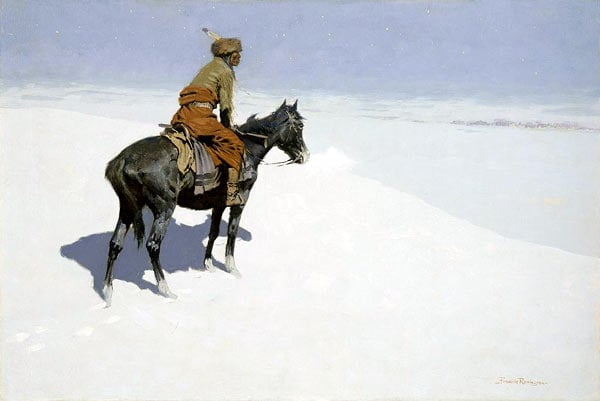
"The Scout: Friends or Foes?" (ca. 1905) by Frederic Remington
Style: Impressionism
Genre: Genre painting (Western scene)
Expert Analysis
Though Frederic Remington is primarily celebrated for his rugged, realistic depictions of the American West, "The Scout: Friends or Foes?" marks a pivotal departure into Impressionism—a stylistic shift he embraced late in his career, influenced by his travels to Europe and exposure to the works of Monet and Sargent. This painting is significant precisely because it marries Remington’s signature narrative of frontier tension with the atmospheric, color-driven techniques of Impressionism, creating a work that is both a genre scene and a study in light and mood.
Subject and Narrative:
A lone scout pauses on horseback atop a dusty ridge, peering toward a distant, hazy horizon. The title explicitly frames the moment of suspense—the scout must decide whether the figures ahead are friend or foe. This is quintessential Remington subject matter: the solitary Westerner, the raw edge of civilization, the constant threat of conflict. Yet here, the drama is not in sharp detail but in suggestion. The scout’s posture is alert but not overtly aggressive, and the uncertainty of the situation is mirrored by the soft, blurred edges of the landscape.
Significance within Impressionism:
Remington applies an Impressionist palette of warm ochres, muted greens, and pale blues, breaking forms into dappled strokes rather than precise outlines. The sunlight filters through a thin layer of dust or haze, casting a golden glow that unifies the figure and setting. This is not the crisp, documentary realism of his earlier work; instead, the painting emphasizes atmospheric effect over anecdotal detail. The horse’s flanks and the scout’s hat are built from quick, visible brushwork, giving the scene a sense of transient light and passing time.
Why It Matters:
"The Scout: Friends or Foes?" stands as a bold experiment by an artist who had built his reputation on narrative clarity. By adopting Impressionism, Remington challenges the notion that Western art must be purely illustrative. He proves that the emotional core of a frontier story—the tension of the unknown—can be conveyed as powerfully through color and light as through action and accuracy. This work thus bridges two worlds: the American West as a place of mythic confrontation, and the European-influenced modernism that sought to capture fleeting perception. It remains a touchstone for how genre painting can transcend storytelling to become pure visual poetry.
Visuell ähnlich
20 Werke mit ähnlicher Komposition und Farbpalette
Pool in the Desert
Frederic Remington
A Cree Indian
Charles M. Russell
Two Chinese horsemen on the steppe
Vasily Vereshchagin
The Navajo
Maynard Dixon
Kyrgyz
Vasily Vereshchagin
A Reconnaissance
Frederic Remington
About the war
Vasily Vereshchagin
On guard
Arkady Rylov
RESTING COSSAKS
Bohdan von Kleczynski
Chinese riders
Vasily Vereshchagin
Free Trappers
Charles M. Russell
Watch
Ilya Repin
Crees Coming in to Trade
Charles M. Russell
The Hunting Party [No. 3]
Charles M. Russell
Caught in the Act
Charles M. Russell
The Return
Gustave Boulanger
Kalmyk-lama
Vasily Vereshchagin
Two Knights in Armor
Henri de Toulouse-Lautrec
Erfolgreiche Plünderer
Franz Roubaud
The Bridal Path, White Mountains
Winslow Homer