Analisi esperta di Ananuri di Vasily Vereshchagin
Stile: Realism, Orientalism · Genere: sketch and study
Expert Analysis of "Ananuri" by Vasily Vereshchagin
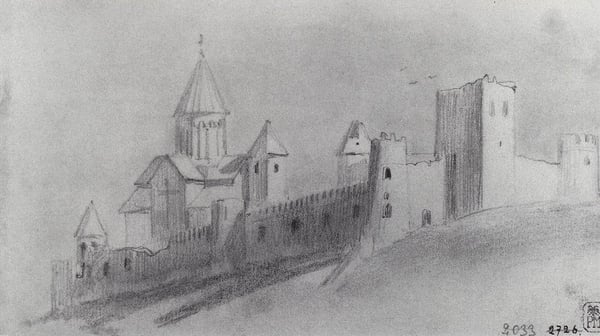
Vasily Vereshchagin’s “Ananuri” (a sketch and study) occupies a crucial position within both the Realist and Orientalist movements of the late 19th century. As a work that captures the medieval Ananuri fortress in Georgia—then part of the Russian Empire—it exemplifies Vereshchagin’s signature approach: the fusion of rigorous topographic accuracy with a palpable sense of place, rooted in his firsthand experiences as a traveler and war correspondent.
Significance within Realism: In the context of Realism, “Ananuri” is not a polished, heroic landscape but a direct, observational study. Vereshchagin rejected the romanticized ruins often favored by earlier painters. Instead, he records the fortress’s weathered stone, steep hillside setting, and the specific quality of Caucasian light with documentary precision. This sketch-like quality—loose brushwork, selective detail, and a focus on atmospheric conditions—demonstrates his belief that truth to immediate perception outweighs idealized composition. It aligns with Realism’s core mission: depicting the world as it is, even in remote or unfamiliar locales.
Significance within Orientalism: For Orientalism, “Ananuri” is significant because it represents a shift away from the Western fantasy of the “Orient” toward a more ethnographic, sober gaze. Vereshchagin traveled extensively through Central Asia, the Caucasus, and India, and his sketches served as visual field notes. Here, the fortress is not a backdrop for exotic narratives but a tangible artifact of a living culture—rustic, defensively practical, and rooted in its geography. The work challenges the typical Orientalist trope of opulent decay by presenting a stark, almost austere architectural study that emphasizes historical endurance over sensual decoration.
Artistic and Historical Significance: As a “sketch and study,” “Ananuri” reveals Vereshchagin’s working method: he produced numerous such studies en plein air to capture fleeting effects of light and texture, later incorporating them into larger, finished paintings—often battle scenes or ethnographic tableaux. This piece thus offers insight into the artist’s technical process and his role as a visual historian. Its significance also lies in its subject: the Ananuri complex, a symbol of Georgian resistance and heritage, viewed through a Russian artist’s lens during a period of imperial expansion. Vereshchagin’s refusal to sentimentalize or exoticize the site makes “Ananuri” a rare, honest document of cross-cultural encounter within 19th-century Orientalist art.
Visivamente simili
20 opere con composizione e palette affini
The Castle at Trento
Albrecht Durer
The Treasure of Carcassonne
Dorothy Lathrop
The Treasure of Carcassonne
Dorothy Lathrop
South of Bellinzona
J.M.W. Turner
Illustration to a poem by Firdausi 'Shahnameh'
Martiros Sarian
Yaroslavna's Lament
Nicholas Roerich
Ominous
Nicholas Roerich

Gazing Ball (El Greco View of Toledo)
Jeff Koons
Alnwick Castle
Canaletto
Vue de l'Alhambra de Grenade, Espagne
Alexandre-Hyacinthe Dunouy
МОНАСТЫРЬ ТЕГЕР
Vlad Avanesov
Near the church
HRASARKOS
Saghmosavank
Petros Malayan
Голубь мира. Здесь будет черный сад.
Vlad Avanesov
View of a fortification of Jerusalem
Jacopo Bellini
Genoese fortress
Konstantin Bogaevsky
Castle. The Doomed City.
Nicholas Roerich
Castle Nègrepeliss
Jean-Honore Fragonard
Otto of the Silver Hand 2
Howard Pyle
Smolensk
Nicholas Roerich