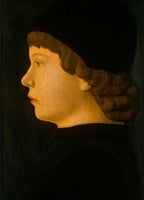
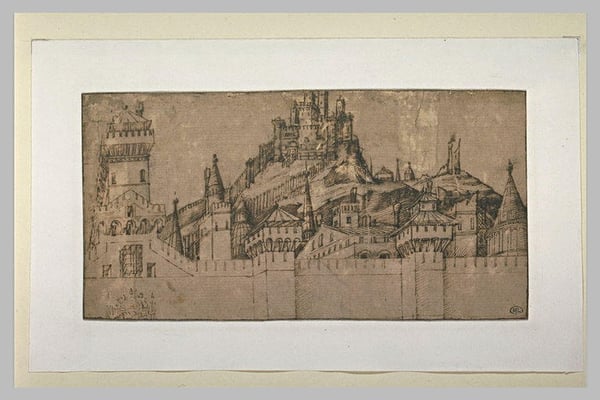
View of a fortification of Jerusalem
Jacopo Bellini sanatçısının View of a fortification of Jerusalem eseri hakkında uzman analizi
Tarz: Early Renaissance · Tür: sketch and study
Expert Analysis: "View of a Fortification of Jerusalem" by Jacopo Bellini
Jacopo Bellini’s View of a Fortification of Jerusalem is a quintessential example of Early Renaissance draftsmanship, offering a rare glimpse into the artist’s working process and the intellectual preoccupations of the period. As a sketch and study, this work transcends mere architectural documentation; it embodies the Renaissance drive to merge empirical observation with classical ideals, to reconstruct the ancient world, and to master linear perspective.
Significance within the Early Renaissance and Bellini’s Oeuvre
-
The Role of the Sketchbook
Jacopo Bellini is celebrated for his two surviving sketchbooks (now in the Louvre and the British Museum), which are among the most important records of artistic practice in the 15th century. Unlike finished paintings, these studies reveal the artist’s raw curiosity. This work belongs to that tradition: it is not a topographical postcard but a preparatory investigation of structure, light, and space. Its status as a “study” elevates its significance, as it shows Bellini experimenting with architectural forms that would later appear in larger compositions for his sons Gentile and Giovanni. -
Perspective and the Rationalization of Space
In the early 1400s, the systematic use of linear perspective was still being codified (Brunelleschi’s experiments date only a few decades earlier). Bellini’s sketch demonstrates his engagement with this new science: note the converging orthogonals of the fortification walls, the diminished scale of towers, and the careful recession of the crenellations. The viewpoint is intentionally low, emphasizing the monumentality of the structure—a technique borrowed from Roman relief sculpture. This is not a fanciful medieval castle; it is a mathematically governed, believable space that invites the viewer’s eye to travel from foreground ramparts to distant hills. -
Architectural Hybridity and the “Jerusalem” Theme
The title “Jerusalem” is significant because it situates the sketch within a Renaissance obsession: the desire to reconstruct the holy city—both physically and symbolically. Bellini likely never visited the Holy Land; his fortification is an imaginative synthesis based on Crusader accounts, Roman castra planning, and contemporary Venetian military architecture. The round towers and heavy masonry recall late Roman castella, while the rectangular gate could derive from Byzantine or early Islamic sources. This eclecticism mirrors the Renaissance habit of using antiquity as a model for contemporary innovation. -
The Sketch as a Work of Art in Its Own Right
Unlike many earlier drawings that were mere underdrawings, Bellini’s sketch exhibits a controlled vigor—the rapid hatching of shadow, the precise definition of stone courses, the delicate indication of foliage. The unfinished quality is intentional: it captures a moment of thought, where the artist tests how a wall meets a bastion or how light falls on a parapet. This spontaneity was revolutionary, elevating the sketch from a tool to an autonomous expression of intellect and creativity.
Influence and Legacy
This study directly informs the panoramic cityscapes painted by his son Gentile Bellini (e.g., Procession in Piazza San Marco) and the architectural backdrops of Giovanni Bellini. It also anticipates the Venetian veduta tradition—the meticulous city view—that would flourish with Canaletto and Guardi. More profoundly, it shows how Early Renaissance artists used drawing to reconcile faith, history, and reason: a holy city made tangible through geometry.
In sum, View of a Fortification of Jerusalem is significant not for its accuracy as a historical record—it is a fiction—but for what it reveals about the Renaissance mind: the confident belief that through art, one could rebuild the past and impose order on the world.
Museum / Gallery
Görsel olarak benzer
İlişkili kompozisyon ve renk paletine sahip 20 eser
Vignette for book "N. K. Roerich"
Nicholas Roerich
Luxembourg, the capital of the Duchy
Joan Blaeu
Ominous
Nicholas Roerich
Vignette for book "N. K. Roerich"
Nicholas Roerich
A Plan of Rome
Limbourg brothers
St. Anthony
Albrecht Durer
Moscow
Ivan Bilibin
The Vicious Town
Nicholas Roerich
St Anthony at the City
Albrecht Durer
Tavola Strozzi
Francesco Pagano
The Mass of Saint Michael
Limbourg brothers
Light night
Nicholas Roerich
The 1530 Siege of Florence
Giorgio Vasari
Fairest City - the anger for enemies
Nicholas Roerich
Calendar: September (Grape Picking)
Limbourg brothers
Jeanne d'Arc. Prayer.
Nicholas Roerich
A sea monster bearing away a princess
Albrecht Durer
Calendar: March (Peasants at Work on a Feudal Estate)
Limbourg brothers
Drawing from the magazine "World of Art"
Ivan Bilibin
Castle Nègrepeliss
Jean-Honore Fragonard