
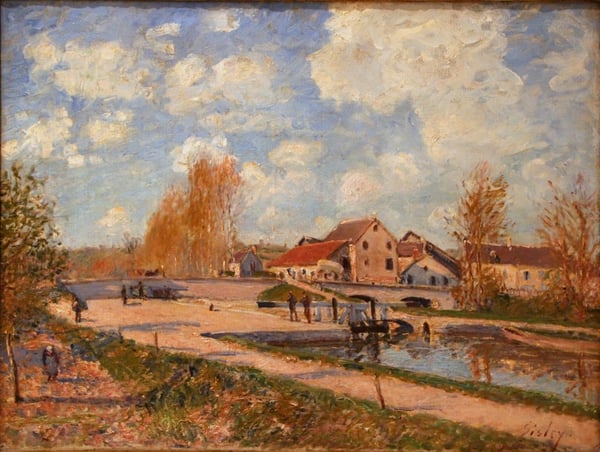
Expert analysis of Alfred Sisley’s The Bourgogne Lock at Moret, Spring
Style: Impressionism · Genre: landscape
Expert Analysis: "The Bourgogne Lock at Moret, Spring" by Alfred Sisley
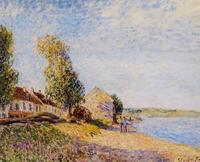
Alfred Sisley’s The Bourgogne Lock at Moret, Spring is a quintessential example of Impressionist landscape painting, demonstrating the artist’s unwavering dedication to capturing the transient effects of light and atmosphere on the French countryside. Painted during a period when Sisley had settled near Moret-sur-Loing, this work reflects his deep engagement with a specific locale—a lock on the Loing River—revisited across seasons and times of day.
Significance within Impressionism and Sisley’s Oeuvre:
-
Mastery of Water and Reflection: Sisley was arguably the most consistent Impressionist in his treatment of water. In this spring scene, the lock’s still basin reflects the pale sky, budding trees, and stone structures with remarkable delicacy. Rather than using stark contrasts, he builds the surface through broken, feathery brushstrokes that seem to shimmer, dissolving solid forms into ripples and light. This dissolution of hard edges is a hallmark of high Impressionism, but Sisley’s application is notably serene and constructed—never chaotic.
-
Subtle Seasonal Palette: The “spring” subtitle is not incidental. Sisley employs a restrained harmony of soft greens, blues, and pale ochers, avoiding the intense chroma of Monet’s garden scenes. The cool silvery light of early spring, with its muted shadows and hazy horizon, is rendered through closely valued tones. This atmospheric nuance—what critics have called “Sisley’s quiet poetry”—allows the viewer to feel the freshness and tentative warmth of the season, rather than simply see it.
-
Structured Composition in an Impressionist Mode: Although Impressionism often rejected academic composition, Sisley here retains a balanced, almost classical structure: the lock gates and stone bank anchor the left foreground, while the bridge and distant architecture frame the right middle ground. The diagonal of the riverbank leads the eye into depth without disrupting the overall serenity. This marriage of plein-air spontaneity with careful ordering makes the work a bridge between the Barbizon school’s naturalism and later Post-Impressionist structure.
-
A Document of Sisley’s Final, Focused Period: Unlike many Impressionists who expanded their subjects globally, Sisley committed to the Moret region from the 1880s onward. The Bourgogne Lock series (he painted several versions) represents his sustained investigation of a single motif—a practice that would influence Cézanne and later Monet’s series. The work is significant as a testament to how even a mundane infrastructure like a lock could become a vehicle for profound observations of light and atmosphere.
In summary, this painting is significant not for dramatic innovation but for its exquisite refinement of Impressionist principles: the fidelity to optical sensation, the dissolution of form in light, and the emotional resonance of a specific place in a specific season. Sisley’s “The Bourgogne Lock at Moret, Spring” stands as a quiet masterpiece of landscape painting, reminding us that Impressionism’s greatest achievements often lie in the most subtle modulations of atmosphere and the steadfast contemplation of nature.
Museum / Gallery
Visually similar
20 works with related composition and palette
Loing Dam at Saint Mammes
Alfred Sisley
Canal du Loing Chemin de Halage
Alfred Sisley
Saint Mammes Dam
Alfred Sisley
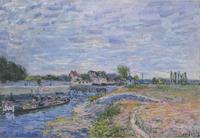
The Dam at Saint Mammes
Alfred Sisley
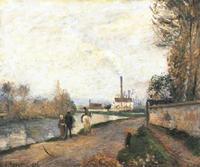
The Oise at Pontoise in Bad Weather
Camille Pissarro
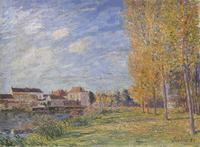
Indian Summer at Moret Sunday Afternoon
Alfred Sisley
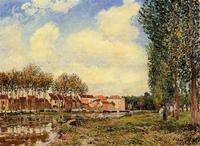
Banks of the Loing at Moret, Morning
Alfred Sisley
On the Banks of the Loing Canal
Alfred Sisley
Morning Sun, Saint Mammes
Alfred Sisley
The Dam, Loing Canal at Saint Mammes
Alfred Sisley
Barges on the Loing, Saint Mammes
Alfred Sisley
The Loing Canal
Alfred Sisley
The Loing at Saint Mammes
Alfred Sisley
Moret Sur Loing
Alfred Sisley
Loing Canal at Saint Mammes
Alfred Sisley
Saint Mammes
Alfred Sisley
By the Oise at Parmain
Gustave Loiseau
A Canal at St. Mammes
Francis Picabia
Matratat s Boatyard, Moret sur Loing
Alfred Sisley
Saint Mammes
Alfred Sisley