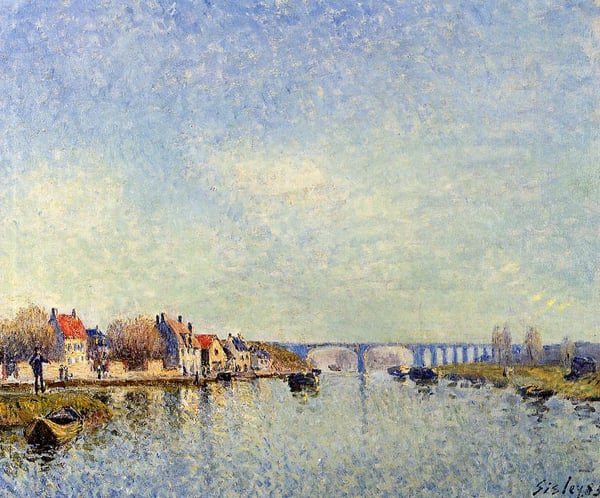
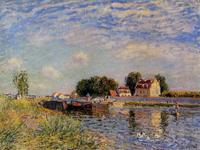
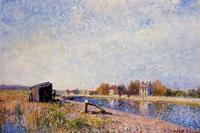
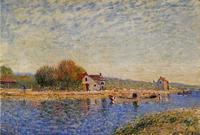
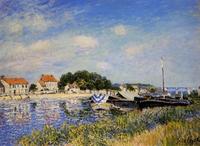
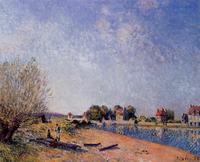
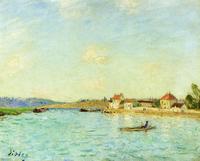
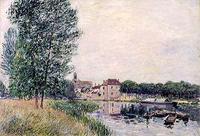
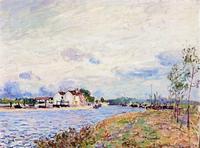
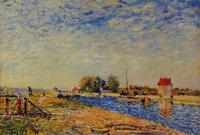
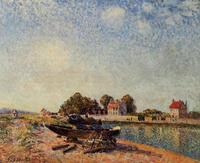
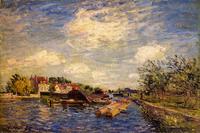
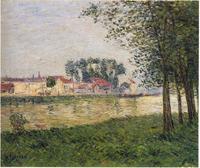
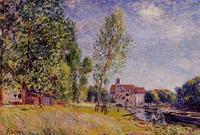
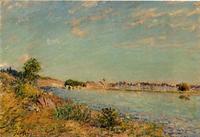
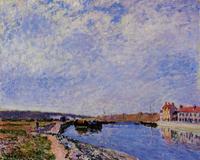
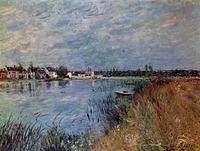
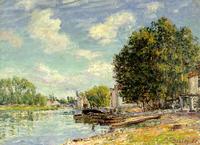
Alfred Sisley’s "Banks of the Loing at Saint Mammes" is a quintessential Impressionist landscape that captures the transient effects of light and atmosphere on a river scene. Executed in the open air (plein air) tradition, the painting focuses on the shimmering surface of the Loing River, the soft reflections of trees and sky, and the delicate interplay of cool blues and warm earth tones. Sisley’s loose, visible brushwork and broken color—hallmarks of the Impressionist style—convey the fleeting quality of a specific moment, likely a calm afternoon.
The significance of this work lies in Sisley’s unwavering dedication to pure landscape as a vehicle for exploring perception and light. Unlike many of his Impressionist peers who often included figures or urban scenes, Sisley concentrated almost exclusively on unpeopled riverbanks, fields, and skies. Here, the absence of human activity focuses attention on the natural world’s sensory experience: the breeze on the water, the dappled sunlight filtering through foliage.
Additionally, "Banks of the Loing at Saint Mammes" is part of a series Sisley painted in the late 1880s along the Loing River, a locale he returned to repeatedly. This serial approach—similar to Monet’s haystacks or Rouen Cathedral—allowed Sisley to systematically study how atmospheric conditions (time of day, season, weather) transform the same motif. The painting thus exemplifies Impressionism’s core ambition: not to depict a place, but to record a sensation of looking.