
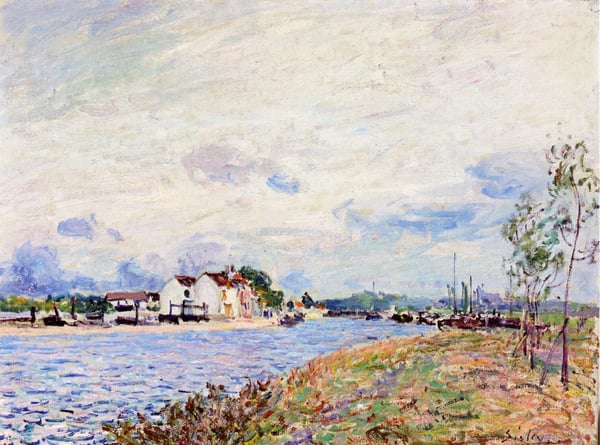
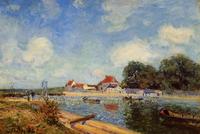
The Mouth of the Loing at Saint Mammes
Dettagli
Analisi esperta di The Mouth of the Loing at Saint Mammes di Alfred Sisley
Stile: Impressionism · Genere: landscape
Alfred Sisley’s The Mouth of the Loing at Saint‑Mammes is a quintessential example of Impressionist landscape painting, distinguished by its serene, almost meditative engagement with a specific locale. Unlike many of his contemporaries who frequently painted figures or urban scenes, Sisley remained steadfastly devoted to pure landscape, and this work embodies his singular talent for capturing the subtle, fleeting harmonies of light and water at a river’s confluence.
Significance within Impressionism:
-
Mastery of Atmosphere and Reflection – Sisley was a poet of water and sky. Here, the broad, placid surface of the Loing River reflects a pale, luminous sky, while the distant banks and trees dissolve into soft, vibrating touches of paint. The artist’s handling of reflected light—using broken, complementary strokes of blue, green, and muted ochre—creates a shimmering unity between the river’s surface and the atmosphere above. This technique was central to Impressionism’s goal of rendering visual sensation rather than objective form.
-
Devotion to En Plein Air and Site‑Specificity – Saint‑Mammes, where the Loing meets the Seine, was a favored location for Sisley in the 1880s. He returned repeatedly to paint the same stretch of river under different weather and seasonal conditions, much as Monet did with haystacks and Rouen Cathedral. This painting’s significance lies in its quiet documentation of a particular place at a particular moment—a hallmark of Impressionist fidelity to the “instant”.
-
Subtle Color Harmony and Brushwork – Unlike the more vigorous, broken color of Monet or Pissarro, Sisley’s brushwork here is relatively restrained, with delicate, horizontal strokes that echo the river’s gentle flow. The palette is restrained—soft silvers, pale blues, dusty greens, and touches of warm earth—creating a calm, lyrical mood. This tonal refinement, devoid of dramatic contrasts, demonstrates Sisley’s focus on nuance and his ability to find grandeur in understatement.
-
Compositional Balance – The composition is deceptively simple: the riverbank diagonally leads the eye from the lower left, past reeds and a solitary tree, toward a light‑filled horizon. The distant bridge and town are barely suggested, their forms dematerialized into the atmosphere. This arrangement reflects the Impressionist interest in flattening space and prioritizing optical sensation over traditional perspective.
In summary, The Mouth of the Loing at Saint‑Mammes is significant for its pure embodiment of Sisley’s lifelong artistic commitment: to render the transient poetry of nature through disciplined observation, subtle color, and a painterly touch that feels both spontaneous and refined. It remains a quiet masterpiece of the Impressionist landscape tradition.
Museum / Gallery
Visivamente simili
20 opere con composizione e palette affini
Banks of the Loing at Saint Mammes
Alfred Sisley
Saint Mammes, Ducks on Canal
Alfred Sisley
Saint Mammes Dam
Alfred Sisley
Saint Mammes Dam
Alfred Sisley
The Loing at Saint Mammes
Alfred Sisley
The Barge Port and Saint Mammes
Alfred Sisley
Morning Sun, Saint Mammes
Alfred Sisley
The Dam at Saint Mammes
Alfred Sisley
Riverbank at Saint Mammes
Alfred Sisley
The Dam, Loing Canal at Saint Mammes
Alfred Sisley
The Dam on the Loing Barges
Alfred Sisley
Barges on the Loing, Saint Mammes
Alfred Sisley
Saint Mammes
Alfred Sisley
Banks of the Loing at Saint Mammes
Alfred Sisley
By the Loing
Alfred Sisley
Moret Sur Loing
Alfred Sisley
Three Barges Moored on the Outskirts of an Industrial Town
Albert Dubois-Pillet
The Loing Canal
Alfred Sisley
Loing Canal at Saint Mammes
Alfred Sisley
Loing Dam at Saint Mammes
Alfred Sisley